Battery backup for a garage door opener: one cycle is about 4 Wh, so buy for the start, not the hours
LiftMaster rates a 1/2 HP opener at 6 A and a cycle takes 22 seconds: ten a day is 44 Wh. What the built-in battery does, and five units that clear the start.
Runtime table
How long a battery runs a garage door opener
720 W running 2 W average at 0.25% duty
| Usable battery | 1 kWh | 2 kWh | 4 kWh | 8 kWh |
|---|---|---|---|---|
| Opener running, door in motion | 1.2 h | 2.4 h | 4.7 h | 9.4 h |
| Typical duty, 0.25% of each hour | 19.7 days | 39.4 days | 78.7 days | 157.4 days |
The math: hours = usable Wh × 85% inverter efficiency ÷ (720 W × duty cycle). Columns are usable watt-hours, after the maker's depth-of-discharge limit. LiftMaster's product guide for its 81650, a 1/2 HP AC chain-drive opener, states 120 V AC, 60 Hz and a 6 A current rating, which is 720 W. LiftMaster's 8550W sheet states about 9 inches per second up and 6.5 down, so a 7-foot door takes roughly 9 seconds to open and 13 to close: about 22 seconds of motor per full cycle, or 4.4 Wh. The duty row is ten full cycles a day. The start-up draw is not published, which is why every pick carries at least 1,800 W of continuous output. Wattage source: spec sheet.
This appliance is already ticked in the sizing calculator: add the rest of your house →
A garage door opener is the smallest motor load in the house and the one people size most wrongly. LiftMaster rates its 1/2 HP chain-drive opener at 6 A, which is 720 W while the door moves, and a full open-and-close takes about 22 seconds, so one cycle is about 4 Wh. Ten cycles a day is 44 Wh, which a 1 kWh unit carries for about three weeks. The battery you need is tiny; the inverter is not, because a motor starts hard. And if your opener has a battery compartment, the maker’s own pack is the answer and the rest of this page is for the refrigerator beside it.
Look for the battery compartment first
Since July 1, 2019, every residential opener sold or installed in California has had to include a battery backup, under SB 969, passed after the 2017 fires trapped people behind doors they could not lift. Chamberlain’s SB 969 notes list its models that carry one (the LiftMaster 8500W, WLED and 8550W, and Chamberlain’s B1381, B970 and C870), and plenty of openers sold elsewhere have the compartment too. It is behind the light lens on the motor unit, with a battery status light beside it.
If yours has one, buy the maker’s pack and nothing else on this page. Chamberlain’s page for its 12 V, 4.5 Ah backup batteries says a fully charged system supplies the motor for one to two days of normal operation during an outage, LiftMaster’s manual says the battery takes 24 hours to fully charge once the power returns, and Chamberlain puts its life at about one to two years. Test it once a season: unplug the opener and run the door.
What one cycle costs
Openers do not print watts. The product guide does: LiftMaster’s 81650 is rated 120 V, 6 A, which is 720 W with the motor running. How long it runs is on the same maker’s sheet for its 8550W: about 9 inches per second up and 6.5 down, so a 7-foot door opens in roughly 9 seconds and closes in 13. Twenty-two seconds at 720 W is 4.4 Wh, and the runtime table above turns that into days. Between cycles the opener waits at about 1 W, LiftMaster’s standby figure for the 8550W with the lights off, so the battery is spent on the door, not on the waiting.
The bar is the start, not the capacity
An AC opener is an induction motor, and an induction motor draws several times its running current for the first fraction of a second, per the running versus surge guide. No opener maker prints that figure. This site’s rule for an unpublished motor is a unit with at least 1,800 W of continuous output and 3,000 W of surge, and it is why the 288 Wh units that carry a router so well are absent here: they hold enough energy for a hundred cycles and cannot supply the first one. The 1 kWh class is the floor, and the two 1 kWh picks are the whole answer for a door on its own. The three larger units are on the page because a garage usually has a refrigerator or a freezer in it, and the door is then the smallest line on the list.
Connecting it, and the one thing not to do
Most openers plug into a receptacle on the garage ceiling. Unplug the cord, run a 15 A rated extension cord down to the unit on the floor, plug the opener into it, and the wall button and remotes work as before; the opener does not care that it was off for an hour, so there is no need to have the unit in place before the outage. An opener wired directly into a circuit, with no plug, is an electrician’s job to back up, through an inlet or a transfer switch like the one the transfer switch guide explains.
The thing not to do is treat the red release cord as the backup. It disconnects the door from the trolley so the door can be lifted by hand, and a balanced door lifts easily and stays put. A door that will not stay up, or that drops when released, has a spring problem, and a spring is a door technician’s part. Pull the cord with the door closed, never open.
The rest of the garage
Add the door to the sizing calculator and it becomes a rounding error next to whatever else is out there: a second refrigerator averages about 52 W around the clock by its label, per the refrigerator page, and a chest freezer about 25 W, per the freezer guide. Either one, not the door, decides the class.
What we left out
Pecron’s E1000LFP, an 1,800 W unit with a stated 3,000 W surge, would have ranked; both of its Amazon listings returned Page Not Found on the check date. Jackery’s Explorer 1500 v2 showed no buy box and two reviews, and its 1500 Ultra three reviews, so one sits as a mention and the other waits. Anker’s C800 Plus and Goal Zero’s Yeti 1000 Core are 1,200 W inverters, under the bar. The 1 kWh units ranked on the refrigerator and sump pages are at this site’s three-page limit, hence the two newer units here.
How we measure
Every pick is scored on the same five criteria. Every capacity, output and certification figure is read from the manufacturer's current spec sheet at write time and dated on the card, and every runtime is computed from those figures with the arithmetic shown. When a maker does not publish a number, the card says "not stated". We never guess one.
-
Usable capacity
The advertised watt-hours against what reaches the outlet: inverter loss, the depth-of-discharge limit and idle self-consumption. We state usable capacity, not the sticker.
-
Output headroom
Continuous and surge watts against the appliances readers actually plug in. A pump that pulls 3 to 5 times its running watts at start trips an underspecced inverter; we check the surge number first.
-
Chemistry and certification
LiFePO4 versus NMC, the rated cycles to 80%, and whether the unit carries UL 2743, UL 9540 or UL 1973. We print the certification status plainly and never treat an uncertified import as equivalent.
-
Recharge and expansion
Wall recharge time, the solar input ceiling and what it means for real charge time, pass-through or UPS switchover, and whether there is an expansion-battery path.
-
Value and warranty
Price per usable kilowatt-hour, weighted by warranty years. A maker that guarantees its cycle rating in writing is telling you something the spec sheet cannot.
Price bands, relative to the picks on this page: $ budget · $$ mid-range · $$$ premium · $$$$ top shelf. Retailer prices move constantly, so we show bands rather than dollar amounts; each button shows the live price.
Best overall
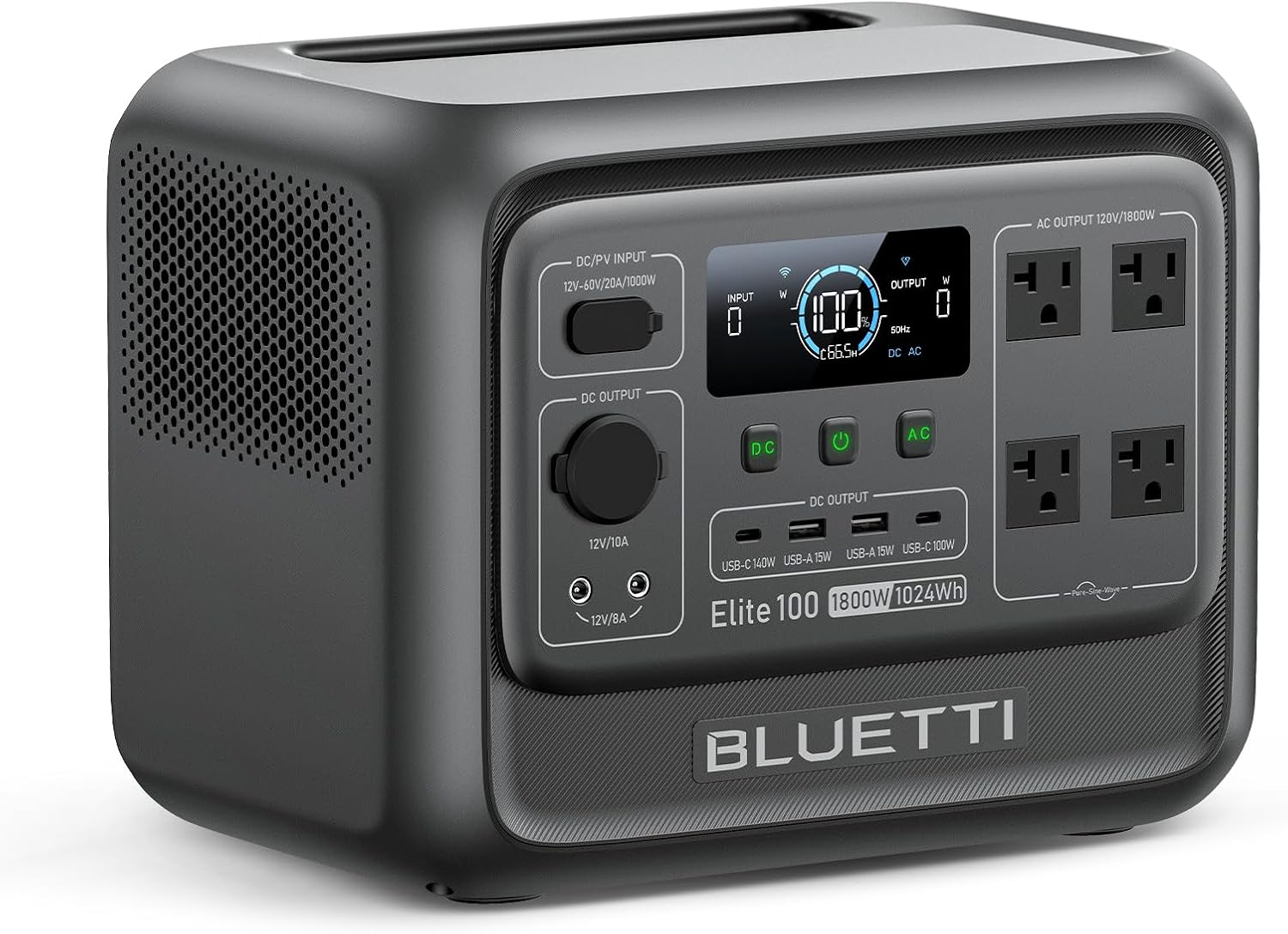
BLUETTI Elite 100 V2
- Advertised
- 1,024 Wh
- Usable, est. 85% inverter
- 870 Wh
- Continuous
- 1,800 W
- Surge
- not stated
- Chemistry
- LiFePO4
- Rated cycles
- 4,000 to 80%
- Weight
- 25 lb
About 870 Wh usable behind an 1,800 W inverter at 25 lb: roughly 200 door cycles on a charge, or about three weeks of ten a day, with a 10 ms UPS so it can live on a shelf beside the opener plugged into the wall. Bluetti states 4,000 cycles to 80% and a 1,000 W solar ceiling. Its 2,700 W Lifting figure is a heating-load mode, not a motor rating, so surge reads not stated.
Pros
- 1,800 W continuous in a 25 lb unit; 4,000 cycles to 80%
- 10 ms UPS mode, so the opener works with nobody home
Cons
- Motor surge not stated; no safety listing stated
Best value
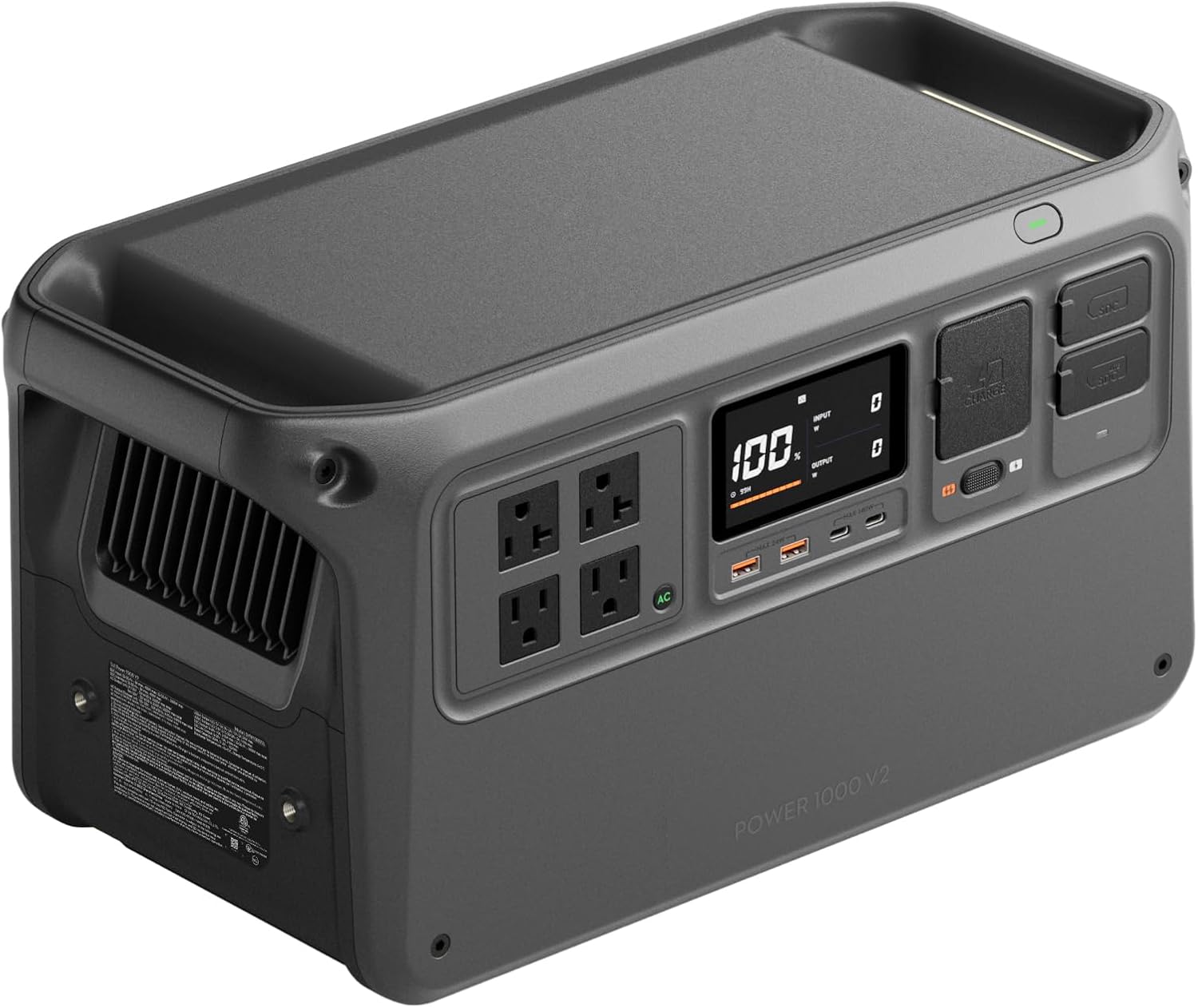
DJI Power 1000 V2
- Advertised
- 1,024 Wh
- Usable, est. 85% inverter
- 870 Wh
- Continuous
- 2,600 W
- Surge
- not stated
- Chemistry
- LFP
- Rated cycles
- not stated
- Weight
- not stated
The same 1,024 Wh class with the most inverter of any 1 kWh unit here: DJI's store page states 2,600 W of stable output, a 10 ms UPS switchover and 80% in 37 minutes from the wall. DJI's US specification page was not reachable on the check date, so cycle count, weight and surge read not stated; the store page is the maker's own and is what the card prints.
Pros
- 2,600 W continuous; 10 ms UPS
- Most reviewed unit in the lineup
Cons
- Cycle basis, weight and surge not stated on the reachable page
Runs the fridge too
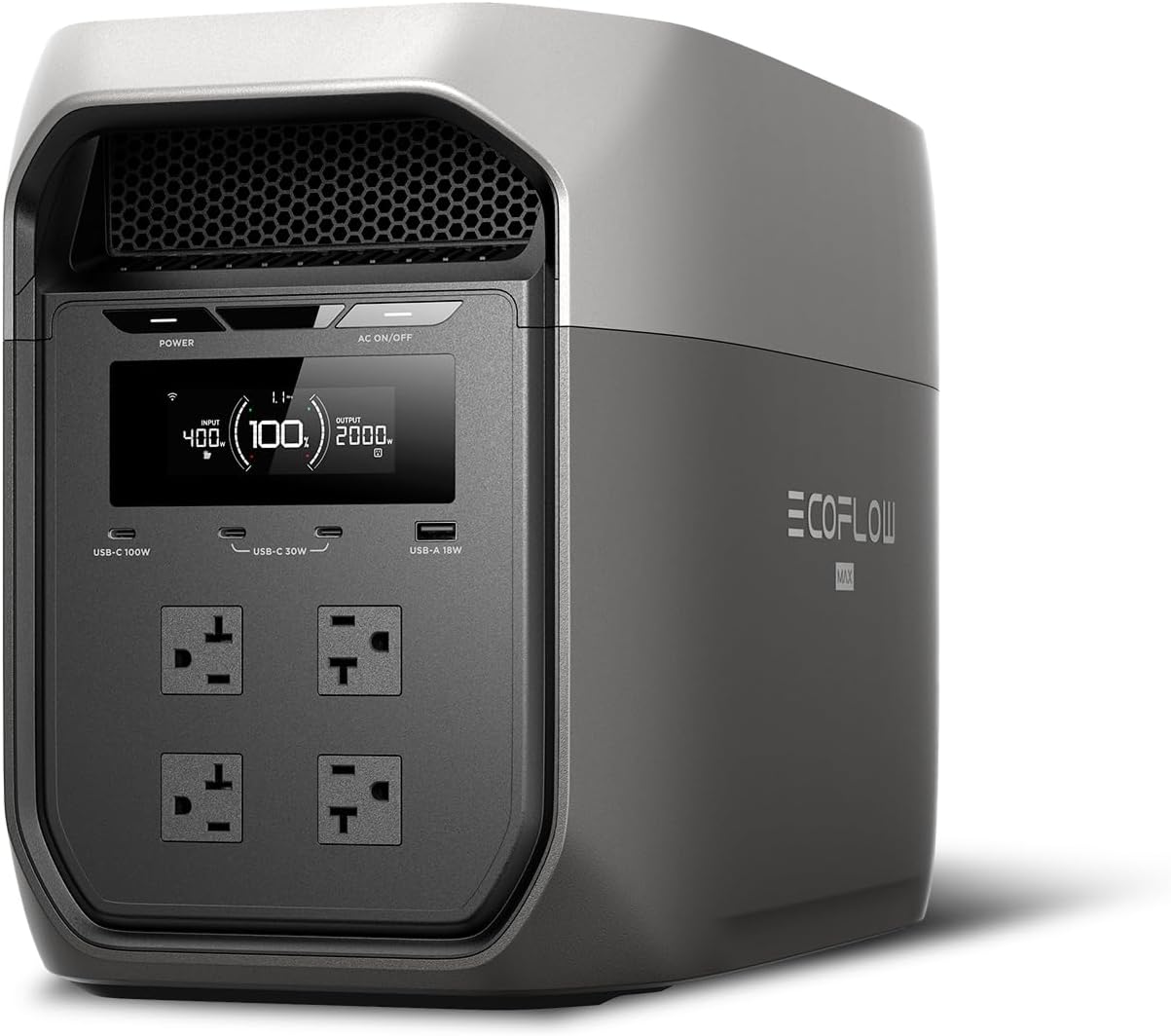
EcoFlow DELTA 3 Max
- Advertised
- 2,048 Wh
- Usable, est. 85% inverter
- 1,741 Wh
- Continuous
- 2,400 W
- Surge
- 4,800 W
- Chemistry
- LiFePO4 (LFP)
- Rated cycles
- not stated
- Weight
- 44.8 lb
About 1,740 Wh usable with a stated 4,800 W surge, the unit to buy when the garage door shares the battery with a refrigerator or a chest freezer. Ten door cycles a day cost it about 3% of a charge; the refrigerator page has the rest of that arithmetic. EcoFlow states the surge as a number rather than a mode, and 240 V is not on the box.
Pros
- Stated 4,800 W surge; 2,400 W continuous
- A day and a half of refrigerator plus the door
Cons
- Cycle count not stated on the maker's page
Most inverter
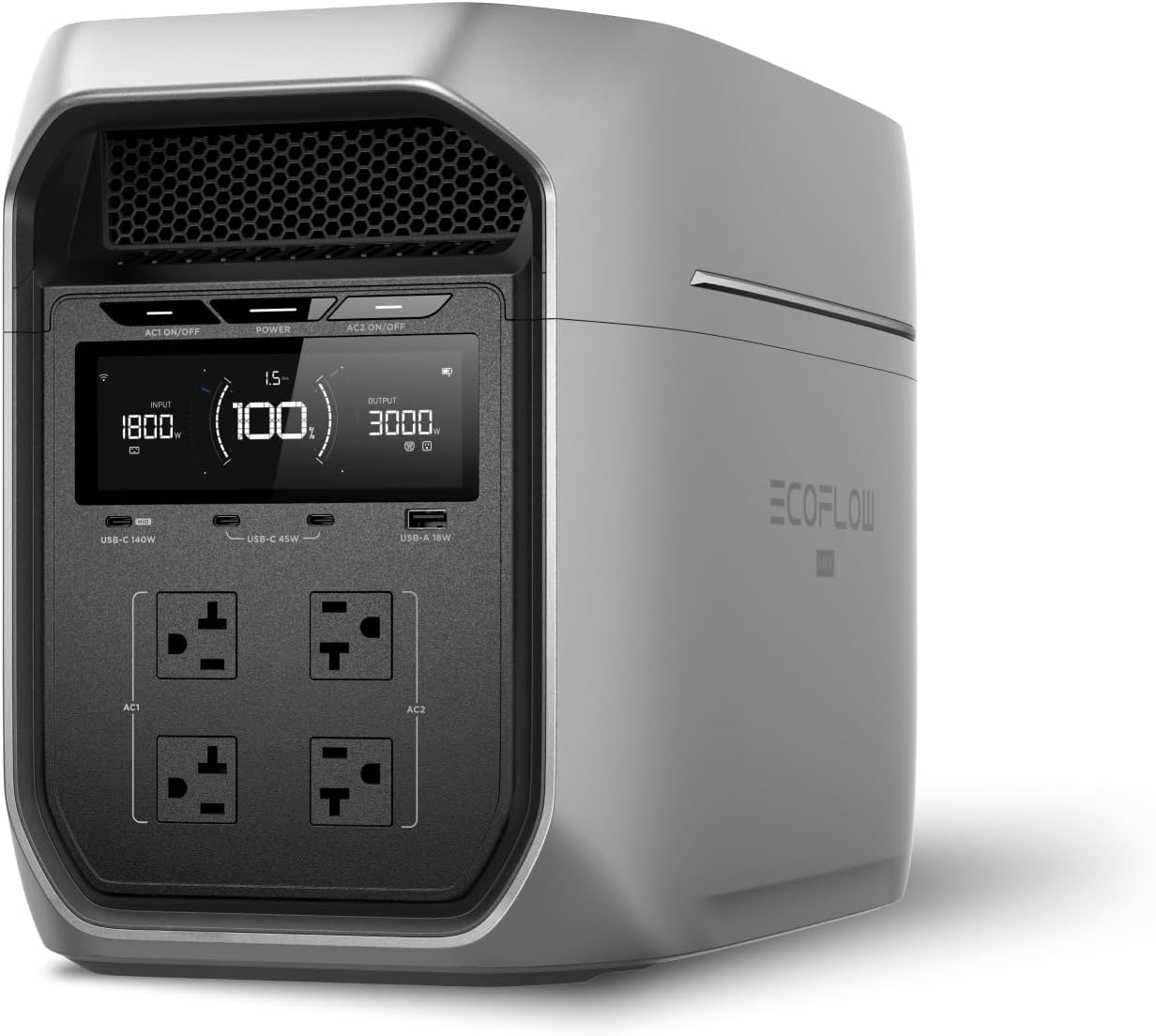
EcoFlow DELTA 3 Max Plus
- Advertised
- 2,048 Wh
- Usable, est. 85% inverter
- 1,741 Wh
- Continuous
- 3,000 W
- Surge
- 6,000 W
- Chemistry
- LiFePO4 (LFP)
- Rated cycles
- not stated
- Weight
- 48.7 lb
The same 2,048 Wh with a 3,000 W inverter and a stated 6,000 W surge, which is the margin for an older opener with a capacitor-start motor, a compressor in the garage fridge and a sump pump in the same outage. Overbuilt for a door on its own; the right unit when the door is the least of the list.
Pros
- Stated 6,000 W surge covers any residential opener
- 3,000 W continuous runs the door, the fridge and a pump together
Cons
- Cycle count not stated; 49 lb
For the whole garage list
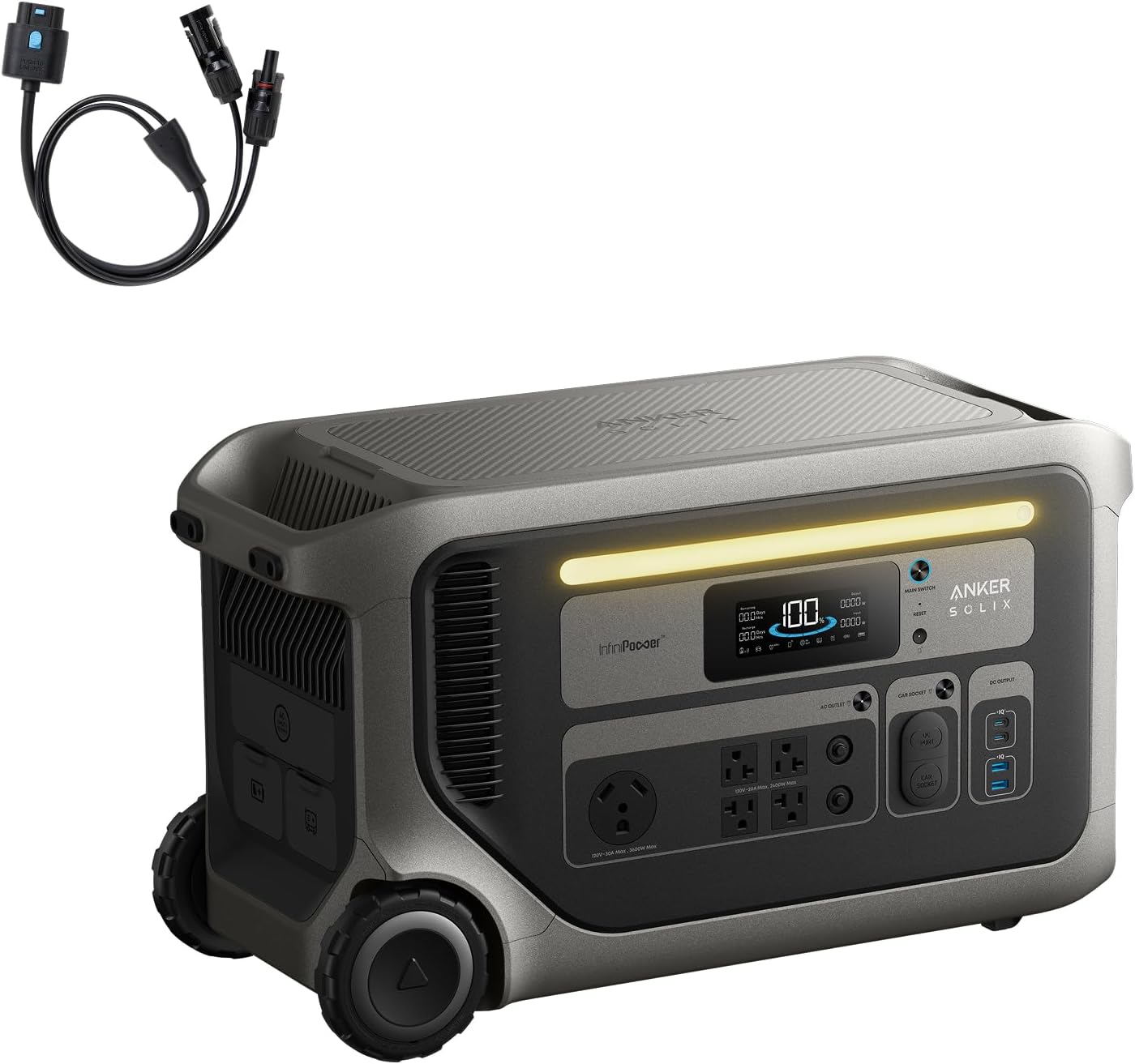
Anker SOLIX F3000
- Advertised
- 3,072 Wh
- Usable, est. 85% inverter
- 2,611 Wh
- Continuous
- 3,600 W
- Surge
- 7,200 W
- Chemistry
- LiFePO4 (LFP)
- Rated cycles
- not stated
- Weight
- 91.5 lb
About 2,600 Wh usable, 3,600 W through a 30 A outlet with a stated 7,200 W surge, and expansion to 24 kWh: a unit bought for a transfer switch and a house, which then opens the garage door as an afterthought. Ninety pounds on wheels. Anker states 4,000 cycles without a capacity basis.
Pros
- Stated 7,200 W surge and a 30 A outlet for an inlet
- Expandable to 24 kWh
Cons
- 91 lb; far more battery than a door needs
Also worth considering
Well-reviewed units that just missed the ranked list. Worth a look if the picks above are not quite right for you.
- EcoFlow DELTA Pro 3,600 Wh with a stated 7,200 W surge and 3,500 cycles to 80%. Still a clean spec sheet; it sits here because the F3000 does the same job for less on the check date, and neither is a purchase for a door alone.
- Jackery Explorer 1500 Ultra 1,536 Wh, 1,800 W with a stated 3,600 W surge and an IP65 rating by its listing and Jackery's page, which suits a garage shelf. Buyable with three reviews on the check date, well under this site's floor of fifty, so it waits.
Frequently asked questions
How many watts does a garage door opener use?
LiftMaster's product guide rates its 1/2 HP AC chain-drive 81650 at 6 A on 120 V, which is 720 W while the door moves. The door moves for about 22 seconds per open-and-close cycle, so a cycle is about 4 Wh at the outlet. LiftMaster states about 1 W in standby for its DC 8550W with the lights off.
Will a small power station open a garage door?
A 288 Wh unit holds enough energy for dozens of cycles, but its 300 to 600 W inverter is below the opener's 720 W running draw before the start-up spike is counted. The makers do not publish the start figure, so this site holds to at least 1,800 W continuous and 3,000 W surge for an unpublished motor, which puts the 1 kWh class at the floor.
How many times will the built-in battery backup open the door?
Chamberlain's own page for its 12 V, 4.5 Ah backup batteries says a fully charged system supplies the motor for one to two days of normal operation during an outage. LiftMaster's manual says the battery takes 24 hours to fully charge once power returns, and its SB 969 notes put battery life at about one to two years.
Can I open the garage door by hand when the power is out?
Yes, with the red emergency release cord, which disconnects the door from the opener's trolley so it can be lifted. A properly balanced door lifts with one hand and stays where you leave it; one that slams down or will not stay up has a spring problem for a door technician, not a battery problem. Pull the release with the door closed, never while it is open.
Does the opener need a UPS switchover?
No. Unlike a router or a CPAP, an opener that loses power for a few seconds simply stops until it is powered again, so a unit can be plugged in after the outage begins. UPS mode is harmless if the unit lives in the garage anyway, and it means the door works without anyone thinking about it.