Battery backup for a sump pump: what actually works, sized from the pump's own numbers
Sized from a real pump's nameplate, not the box: which power stations run a 1/3 HP sump pump through a night of rain, and for how long.
Runtime table
How long a battery runs a 1/3 HP submersible sump pump
1,116 W running 279 W average at 25% duty
| Usable battery | 1 kWh | 2 kWh | 4 kWh | 8 kWh |
|---|---|---|---|---|
| Running continuously | 46 min | 1.5 h | 3.0 h | 6.1 h |
| Typical duty, 25% of each hour | 3.0 h | 6.1 h | 12.2 h | 24.4 h |
The math: hours = usable Wh × 85% inverter efficiency ÷ (1,116 W × duty cycle). Columns are usable watt-hours, after the maker's depth-of-discharge limit. Running watts are the Zoeller M53's nameplate, 9.7 A at 115 V. Zoeller does not publish a locked-rotor figure, so there is no surge line; Liberty publishes 8 A locked rotor against 5.2 A running on its 1/3 HP 257, about 1.5 times. The duty cycle assumes about 15 minutes of pumping per hour in steady rain; in a flash flood the pump runs closer to continuously, so plan from the top row. Wattage source: spec sheet.
This appliance is already ticked in the sizing calculator: add the rest of your house →
A sump pump is the appliance people buy backup power for with water already in the pit, so the verdict comes first and the arithmetic under it. The short version: any of the five picks runs a residential sump pump; how long it runs is the only question, and the runtime table answers it. The rest of this page is what the box will not tell you.
The pump’s real numbers, not the horsepower
Horsepower is a poor guide to draw. Zoeller’s 3/10 HP M53, the most common basement pump in the country, is rated 9.7 A at 115 V, about 1,116 W running. Zoeller’s 1/2 HP M98 is rated 9.4 A, slightly less. Liberty’s 1/3 HP 257 is rated 5.2 A, under 600 W. Three “1/3 to 1/2 HP” pumps span almost a factor of two, which is why the table above is built on one named pump and the sump pump wattage guide lists the others. Read the amps on your own pump’s label and multiply by 115.
Surge is the margin, not the emergency
Every pump article warns that motors draw three to five times their running current at start. That is true of capacitor-start motors, and it is why the surge rating decides whether a battery works at all for a well pump. Submersible sump pumps are gentler: Liberty publishes 8 A locked rotor against 5.2 A running, a ratio of about 1.5. Zoeller does not publish one. So the honest rule for a sump pump is that the inverter’s continuous rating should clear the running draw with real margin, and the surge rating should be large enough to cover a pump you have not measured. Every pick here has at least 1,800 W continuous and 3,000 W surge against an 1,116 W pump. The mechanics are in running watts versus surge watts.
Sizing the night
At a 25% duty cycle the M53 averages 279 W, so eight hours of steady rain is about 2,230 Wh delivered. Inverters lose roughly 15% turning battery watt-hours into outlet watt-hours, which is why the spec strips print a usable figure beside the sticker and why the table’s columns are usable watt-hours; the reasoning is in usable capacity versus advertised. A 2 kWh unit covers most of a night, and the 2 kWh roundup ranks that whole class. If your pump runs more than a quarter of the time, or the storm is longer than a night, the expandable picks are the answer: the DELTA 2 Max and the DELTA 3 Plus both accept extra batteries.
What the certification chips are telling you
Every card on this page says “none stated by the maker” because none of the five makers prints a UL 2743 listing on its product page as of the check date. Several cite a UL94 flame rating for the casing, which is a materials test, not a product safety listing, and we do not upgrade one to the other. If a listing matters to you, and for a device that lives in a wet basement it should, look for the UL mark on the unit itself and ask the maker in writing.
What we left out
Jackery’s Explorer 2000 Plus and 2000 v2 both fit this class on paper and both showed as currently unavailable at Amazon on the check date, so neither is ranked; they return to consideration when they return to stock. The picks are all lithium iron phosphate, which is what lets a unit sit charged for months between storms; the LiFePO4 versus NMC guide explains the trade. Dedicated DC backup pumps are a different product and will get their own page. Wiring a power station into a circuit is transfer-switch territory: read the callout at the top, and hand that part to a licensed electrician.
How we measure
Every pick is scored on the same five criteria. Every capacity, output and certification figure is read from the manufacturer's current spec sheet at write time and dated on the card, and every runtime is computed from those figures with the arithmetic shown. When a maker does not publish a number, the card says "not stated". We never guess one.
-
Usable capacity
The advertised watt-hours against what reaches the outlet: inverter loss, the depth-of-discharge limit and idle self-consumption. We state usable capacity, not the sticker.
-
Output headroom
Continuous and surge watts against the appliances readers actually plug in. A pump that pulls 3 to 5 times its running watts at start trips an underspecced inverter; we check the surge number first.
-
Chemistry and certification
LiFePO4 versus NMC, the rated cycles to 80%, and whether the unit carries UL 2743, UL 9540 or UL 1973. We print the certification status plainly and never treat an uncertified import as equivalent.
-
Recharge and expansion
Wall recharge time, the solar input ceiling and what it means for real charge time, pass-through or UPS switchover, and whether there is an expansion-battery path.
-
Value and warranty
Price per usable kilowatt-hour, weighted by warranty years. A maker that guarantees its cycle rating in writing is telling you something the spec sheet cannot.
Price bands, relative to the picks on this page: $ budget · $$ mid-range · $$$ premium · $$$$ top shelf. Retailer prices move constantly, so we show bands rather than dollar amounts; each button shows the live price.
Best overall
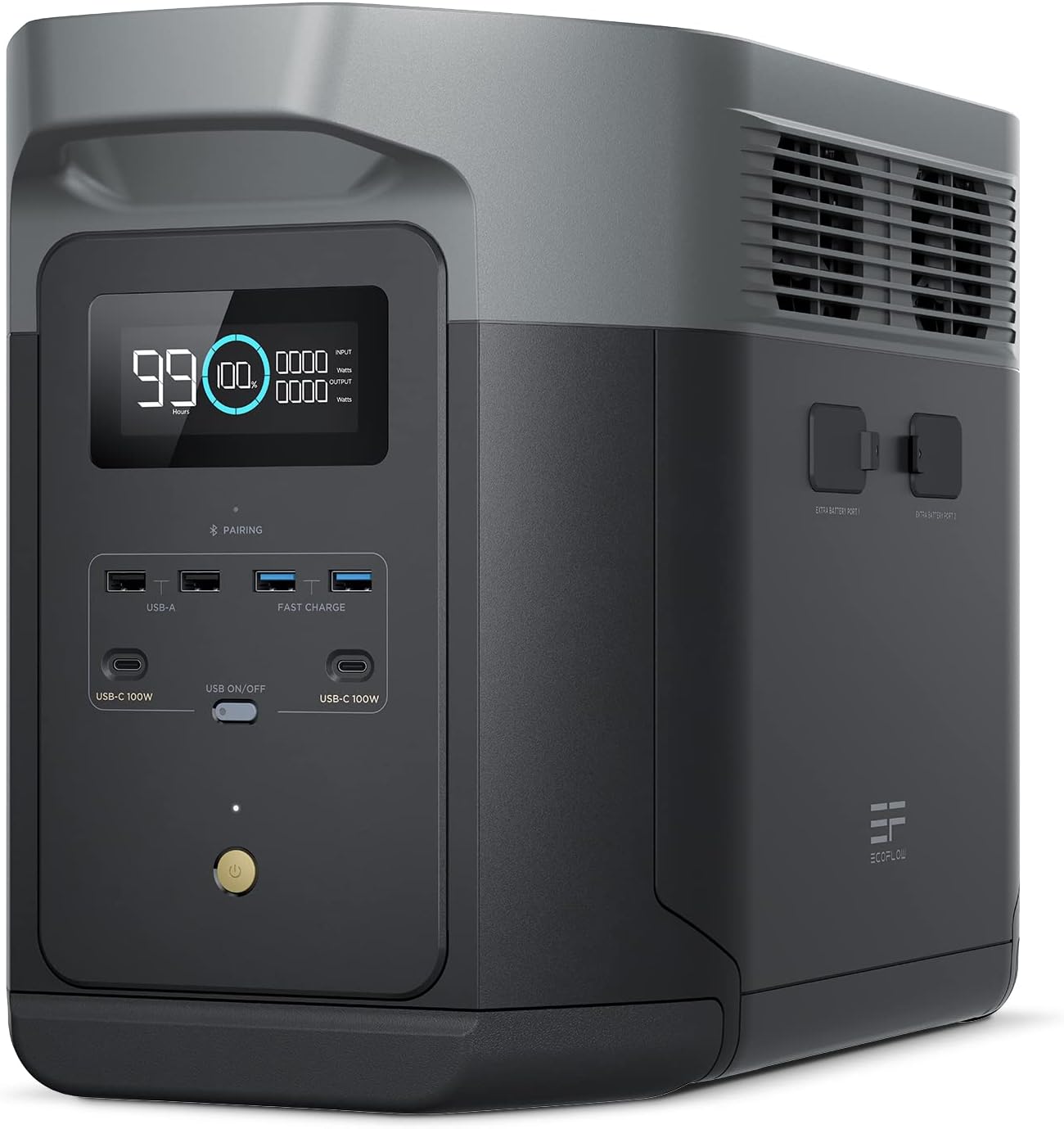
EcoFlow DELTA 2 Max
- Advertised
- 2,048 Wh
- Usable, est. 85% inverter
- 1,741 Wh
- Continuous
- 2,400 W
- Surge
- 4,800 W
- Chemistry
- LiFePO4 (LFP)
- Rated cycles
- 3,000 to 80%
- Weight
- 50 lb
The most surge headroom in the 2 kWh class at 4,800 W, more than four times this pump's running draw, and a 2,048 Wh pack that works out to about 1,740 Wh at the outlet, or six hours of a pump cycling at 25% duty. EcoFlow's page cites a UL94-5VA flame rating for the casing, which is a materials test, not a product safety listing; no UL 2743 listing is stated there. Two extra batteries take it to 6,144 Wh for a week of storms.
Pros
- 4,800 W surge clears any residential sump pump start with room to spare
- Expandable to 6,144 Wh with two extra batteries
- 1,000 W solar input and an 80% AC recharge in about an hour
Cons
- 50 lb is a two-hand carry down basement stairs
- No UL 2743 listing stated on the maker's page
Best value in the 2 kWh class
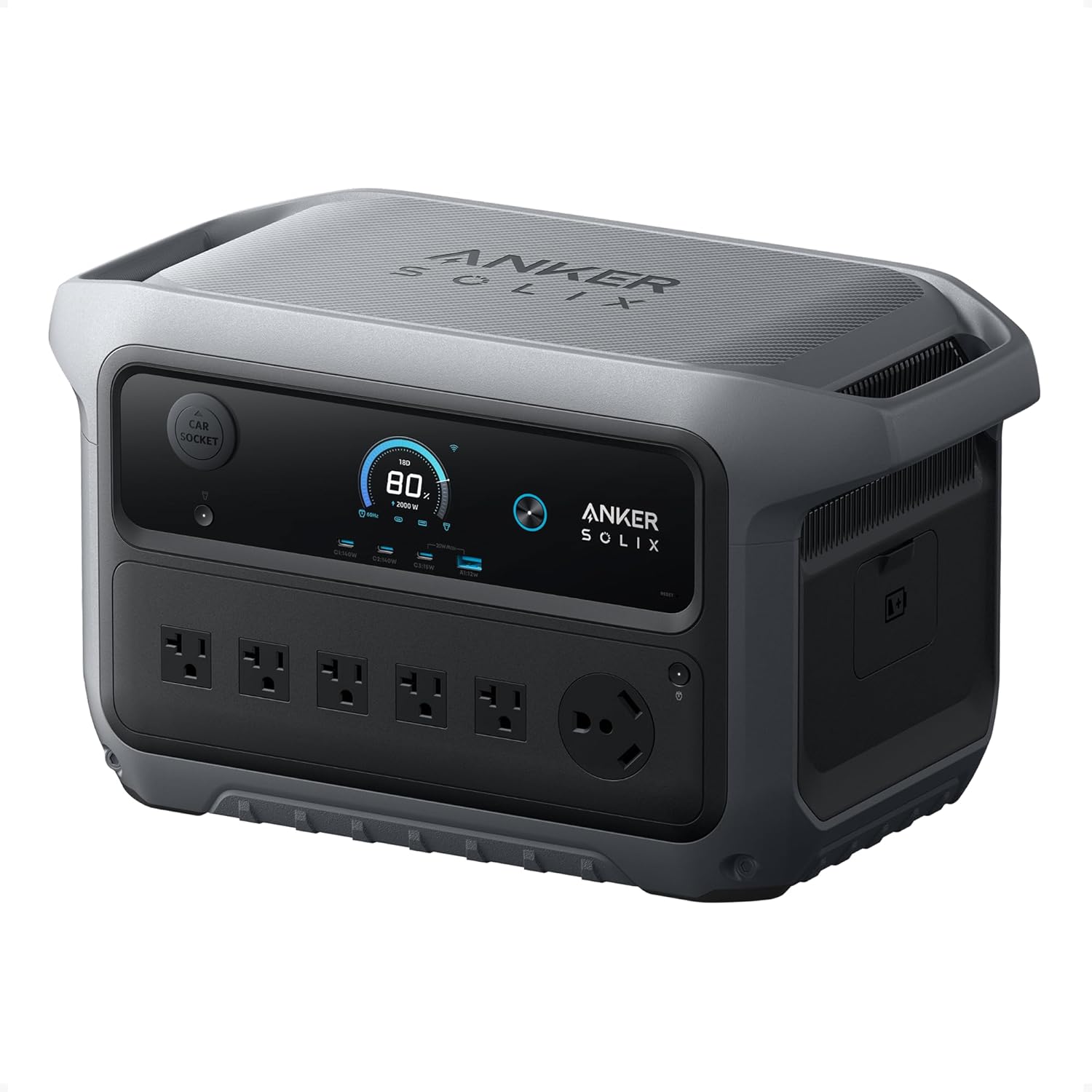
Anker SOLIX C2000 Gen 2
- Advertised
- 2,048 Wh
- Usable, est. 85% inverter
- 1,741 Wh
- Continuous
- 2,400 W
- Surge
- 4,000 W
- Chemistry
- LiFePO4 (LFP)
- Rated cycles
- 4,000 to 80%
- Weight
- 41.7 lb
Same sticker capacity and continuous rating as the DELTA 2 Max, eight pounds lighter, a 4,000-cycle rating instead of 3,000, and a 10 ms UPS switchover that keeps a pump's float switch from seeing the outage at all if the unit sits inline. The trade is solar input, capped at 800 W, and the maker's page states no safety listing.
Pros
- Lightest 2 kWh pick at 41.7 lb
- 4,000 cycles to 80% and a 10 ms UPS switchover
- Full recharge in under an hour from the wall
Cons
- 800 W solar ceiling, lowest of the 2 kWh picks
- No safety certification stated on the maker's page
Longest cycle life
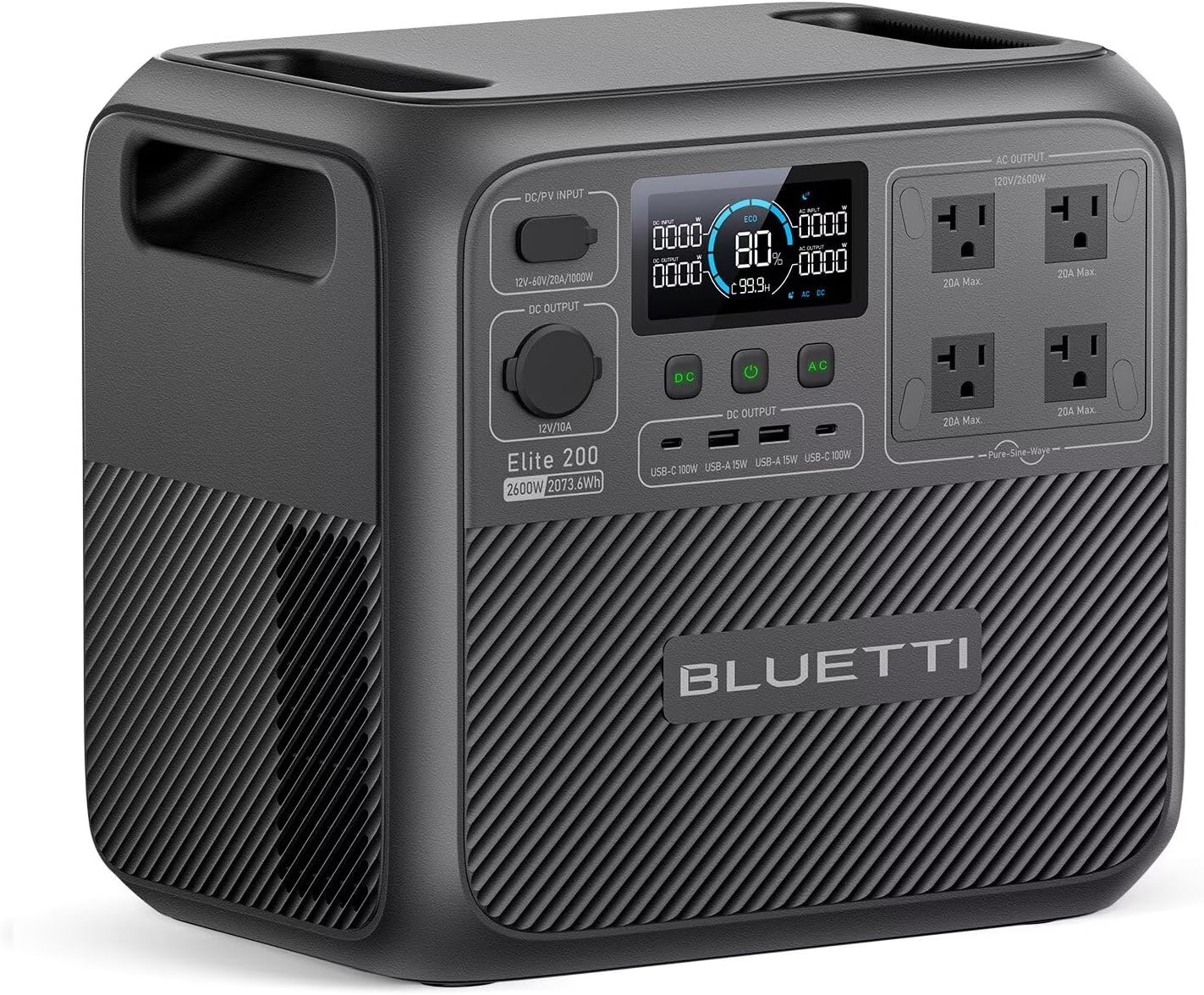
BLUETTI Elite 200 V2
- Advertised
- 2,073.6 Wh
- Usable, est. 85% inverter
- 1,763 Wh
- Continuous
- 2,600 W
- Surge
- not stated
- Chemistry
- LiFePO4 (automotive-grade LFP)
- Rated cycles
- 6,000 to 80%
- Weight
- 53.4 lb
The highest continuous rating here at 2,600 W and a 6,000-cycle pack, which is the pick if the unit will also cycle daily on solar between storms. Bluetti publishes a 3,900 W Power Lifting mode, but only for pure resistive loads like heaters, so it is not a motor surge figure and the card leaves surge as not stated. The Amazon listing claims a 5,200 W peak that the maker's page does not; we print the maker.
Pros
- 6,000 cycles to 80%, double most of the class
- 2,600 W continuous, the most headroom on steady loads
- 0 to 80% from the wall in about an hour
Cons
- True motor surge rating not stated by the maker
- Top-shelf price band in this lineup
Best 1 kWh for a short storm
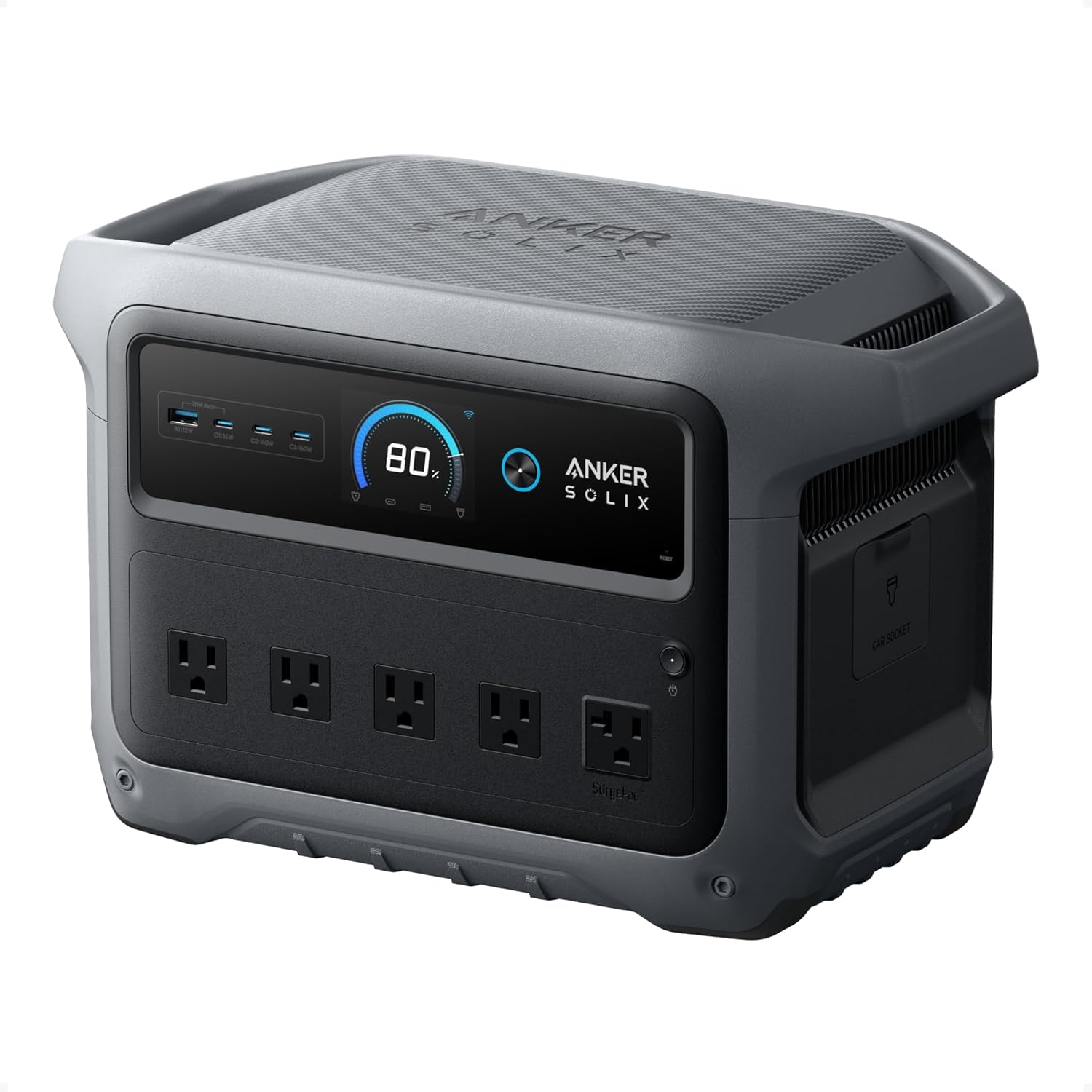
Anker SOLIX C1000 Gen 2
- Advertised
- 1,024 Wh
- Usable, est. 85% inverter
- 870 Wh
- Continuous
- 2,000 W
- Surge
- 3,000 W
- Chemistry
- LiFePO4 (LFP)
- Rated cycles
- 4,000 to 80%
- Weight
- 24.9 lb
Half the capacity of the picks above at half the weight, with a 2,000 W continuous rating that is unusual in the 1 kWh class and clears this pump by almost double. About three hours of cycling at 25% duty, which is a storm, not a night. The 24.9 lb weight is the point: it is the one you actually carry to the pit.
Pros
- 2,000 W continuous and 3,000 W peak in a 25 lb unit
- Full recharge in 49 minutes
Cons
- Roughly three hours of a cycling pump, not a full night
- 600 W solar ceiling
Best 1 kWh to grow later
EcoFlow DELTA 3 Plus
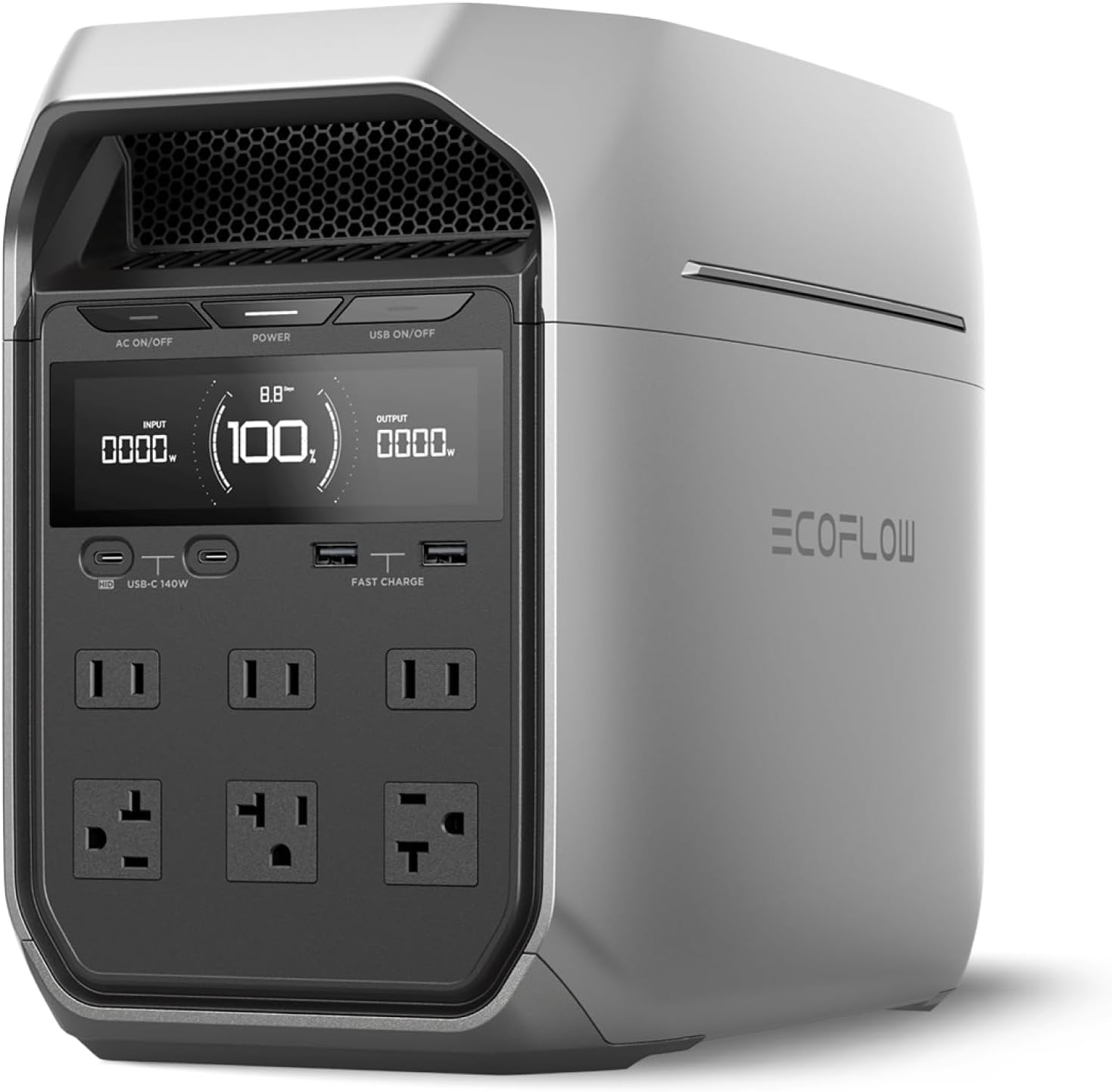
- Advertised
- 1,024 Wh
- Usable, est. 85% inverter
- 870 Wh
- Continuous
- 1,800 W
- Surge
- 3,600 W
- Chemistry
- LiFePO4 (LFP)
- Rated cycles
- 4,000 to 80%
- Weight
- 27.6 lb
The other 1 kWh answer, with a lower continuous rating than the C1000 Gen 2 but a higher surge and a wider expansion path: it accepts EcoFlow's DELTA 2, DELTA 2 Max and DELTA 3 extra batteries, so the unit you buy for one storm can become the 3 kWh system that covers a night. Same 4,000-cycle rating as the Anker.
Pros
- 3,600 W surge, the most of the 1 kWh picks
- Expandable with four different EcoFlow extra batteries
- 10 ms UPS switchover
Cons
- 1,800 W continuous is the lowest in the lineup, still 60% above this pump
- No safety certification stated on the maker's page
Also worth considering
Well-reviewed units that just missed the ranked list. Worth a look if the picks above are not quite right for you.
- BLUETTI AC200L Same 2,048 Wh and 2,400 W as the class leaders with a 30 A RV outlet, but Bluetti's page publishes neither a weight nor a cycle rating for it, and we do not fill blanks from memory.
- Jackery Explorer 1000 v2 1,070 Wh and 1,500 W at 23.8 lb. It clears this pump by a third, which is thinner margin than the two 1 kWh picks, and Jackery rates its cycles to 70% rather than 80%.
- EcoFlow DELTA 3 The DELTA 3 Plus without the faster USB-C and with the same 1,024 Wh and 1,800 W; the right buy when the Plus is out of stock or the band difference matters.
Frequently asked questions
How many watt-hours does a sump pump need for one night?
A 1/3 HP pump drawing 1,116 W at a 25% duty cycle averages 279 W. Eight hours is about 2,230 Wh at the outlet, which is roughly 2,600 Wh of usable battery once 85% inverter efficiency is included. A 2 kWh class unit covers most of a night; two of them, or an expansion battery, covers all of it.
Will a 1,000 Wh power station run a sump pump?
Yes, for a few hours. The 1 kWh units here clear the pump's running draw with margin, and at a 25% duty cycle they run it for roughly three hours. That covers a short storm or bridges the gap until a generator or the grid comes back, not a full night.
Why does the surge rating matter if sump pumps start gently?
Modern submersible sump pumps with shaded-pole or PSC motors do start gently: Liberty publishes 8 A locked rotor on a 5.2 A pump. Older pedestal pumps and capacitor-start motors can pull several times running current. The surge rating is the margin that covers a pump you have not measured, which is why every pick here has at least 3,000 W of it.
Is a dedicated battery backup sump pump better than a power station?
It is a different tool. A dedicated DC backup pump switches over on its own and avoids inverter loss, but it is a second pump with its own float and a lead-acid battery to maintain. A power station runs your existing pump, moves to the refrigerator when the pit is dry, and needs no installation. This page covers the power station path.