Battery backup for a window AC: hours per kWh at 8,000 BTU, and the surge rule that decides the unit
An 8,000 BTU window AC draws 533 W running by its ENERGY STAR figure and cycles about half the time. Five units that clear the compressor rule, with hours.
Runtime table
How long a battery runs a Window air conditioner, 8,000 BTU (Whirlpool WHAW-081IN)
533 W running 267 W average at 50% duty
| Usable battery | 1 kWh | 2 kWh | 4 kWh | 8 kWh |
|---|---|---|---|---|
| 8,000 BTU AC at 50% duty | 1.6 h | 3.2 h | 6.4 h | 12.8 h |
| Typical duty, 50% of each hour | 3.2 h | 6.4 h | 12.8 h | 25.5 h |
The math: hours = usable Wh × 85% inverter efficiency ÷ (533 W × duty cycle). Columns are usable watt-hours, after the maker's depth-of-discharge limit. 8,000 BTU at the listed CEER of 15 is 533 W while the compressor runs. Duty is the thermostat cycling in a hot room; on a mild night it is lower, in a sunny room with the door open it approaches 100%. The compressor's start-up draw is not published, so the picks are held to this site's margin rule: at least 1,800 W continuous and 3,000 W surge. Wattage source: spec sheet.
This appliance is already ticked in the sizing calculator: add the rest of your house →
Air conditioning is the load that turns a battery purchase into a math problem, because a window unit is the one appliance most people own that draws half a kilowatt and starts with a spike its maker never prints. An 8,000 BTU window AC draws about 533 W while its compressor runs, by its own ENERGY STAR figure, and cycles about half the time in a hot room; a 2 kWh unit is a night, a 1 kWh unit is three hours, and only an inverter that clears 1,800 W continuous and 3,000 W surge should be asked to start it. The table above is the arithmetic; the five picks are the units that clear the rule.
Watts from the yellow label, not the box
The EnergyGuide label gives a CEER, the combined energy efficiency ratio, and the BTU rating. Divide one by the other and the result is watts while the compressor runs: 8,000 BTU at a CEER of 15 is 533 W, which is the Whirlpool WHAW-081IN’s ENERGY STAR listing and the figure the table uses. A 6,000 BTU unit at the same efficiency is 400 W; a 12,000 BTU unit is 800 W. The compressor does not run all hour. Once the room reaches the setpoint it cycles, and the share of each hour it runs is the duty cycle that decides the watt-hours: 50% in a hot room with the door shut, less on a mild night, close to 100% in a sunny room with a gap under the door. The watt-hours guide has the conversions, and the sizing calculator lets you set the duty for your room.
The number that is not on the label
A compressor is a capacitor-start motor, and for a fraction of a second at start it draws several times its running current. Window AC makers publish a running amperage and nothing about the start, so there is no figure to size against. This site’s rule for an unpublished compressor, explained in running versus surge watts, is an inverter with at least 1,800 W continuous and 3,000 W surge. Three of the five picks state a surge above that; two meet the continuous half and print a boost-mode figure their makers do not call a surge rating, and their cards say so. A 288 Wh unit with a 600 W inverter, the kind that runs a router for a day, will not start an AC, and a unit that trips on the start is worse than no unit at all, because the room warms while you reset it.
Sizing the night
At 533 W and 50% duty the average is 266 W. Usable capacity, the sticker at 85% inverter efficiency per the usable capacity guide, divided by that average gives the hours: about 3.3 for a 1 kWh unit, 6.5 for 2 kWh, nearly 10 for the 3 kWh F3000. A summer night is eight or nine hours, so the honest class for sleeping through an outage is 2 kWh and up, and the two 1 kWh picks are for the hours after dark before the house cools or for a unit that also has to be carried up the stairs. The 2 kWh roundup compares that class as stations, and the expandable roundup covers the units that grow when one night is not enough.
What a fan does to this page
A box fan draws about a tenth of a window AC and moves the air the body actually feels. On a battery, a fan and a wet towel buys hours of comfort that an AC spends in minutes, and it is the first thing to plug in while the AC waits for the hottest part of the night. The same logic in reverse is on the space heater page: heat and cold are the two loads a battery is worst at, and the cheap alternative is usually the better plan.
What we left out
Every 1 kWh unit ranked elsewhere on this site, the DELTA 3, C1000 Gen 2, AC180, Jackery 1000 v2 and DELTA 3 Plus, would clear the continuous rule here; they are on three pages each already, which is this site’s limit for one product. The Bluetti AC200L publishes neither weight nor cycles on its page and stays an honorable mention elsewhere. No maker here states a UL 2743 listing for a portable power pack; the Anker C1000’s four standards are the exception in the lineup, and the certification guide explains what each covers.
How we measure
Every pick is scored on the same five criteria. Every capacity, output and certification figure is read from the manufacturer's current spec sheet at write time and dated on the card, and every runtime is computed from those figures with the arithmetic shown. When a maker does not publish a number, the card says "not stated". We never guess one.
-
Usable capacity
The advertised watt-hours against what reaches the outlet: inverter loss, the depth-of-discharge limit and idle self-consumption. We state usable capacity, not the sticker.
-
Output headroom
Continuous and surge watts against the appliances readers actually plug in. A pump that pulls 3 to 5 times its running watts at start trips an underspecced inverter; we check the surge number first.
-
Chemistry and certification
LiFePO4 versus NMC, the rated cycles to 80%, and whether the unit carries UL 2743, UL 9540 or UL 1973. We print the certification status plainly and never treat an uncertified import as equivalent.
-
Recharge and expansion
Wall recharge time, the solar input ceiling and what it means for real charge time, pass-through or UPS switchover, and whether there is an expansion-battery path.
-
Value and warranty
Price per usable kilowatt-hour, weighted by warranty years. A maker that guarantees its cycle rating in writing is telling you something the spec sheet cannot.
Price bands, relative to the picks on this page: $ budget · $$ mid-range · $$$ premium · $$$$ top shelf. Retailer prices move constantly, so we show bands rather than dollar amounts; each button shows the live price.
Best overall
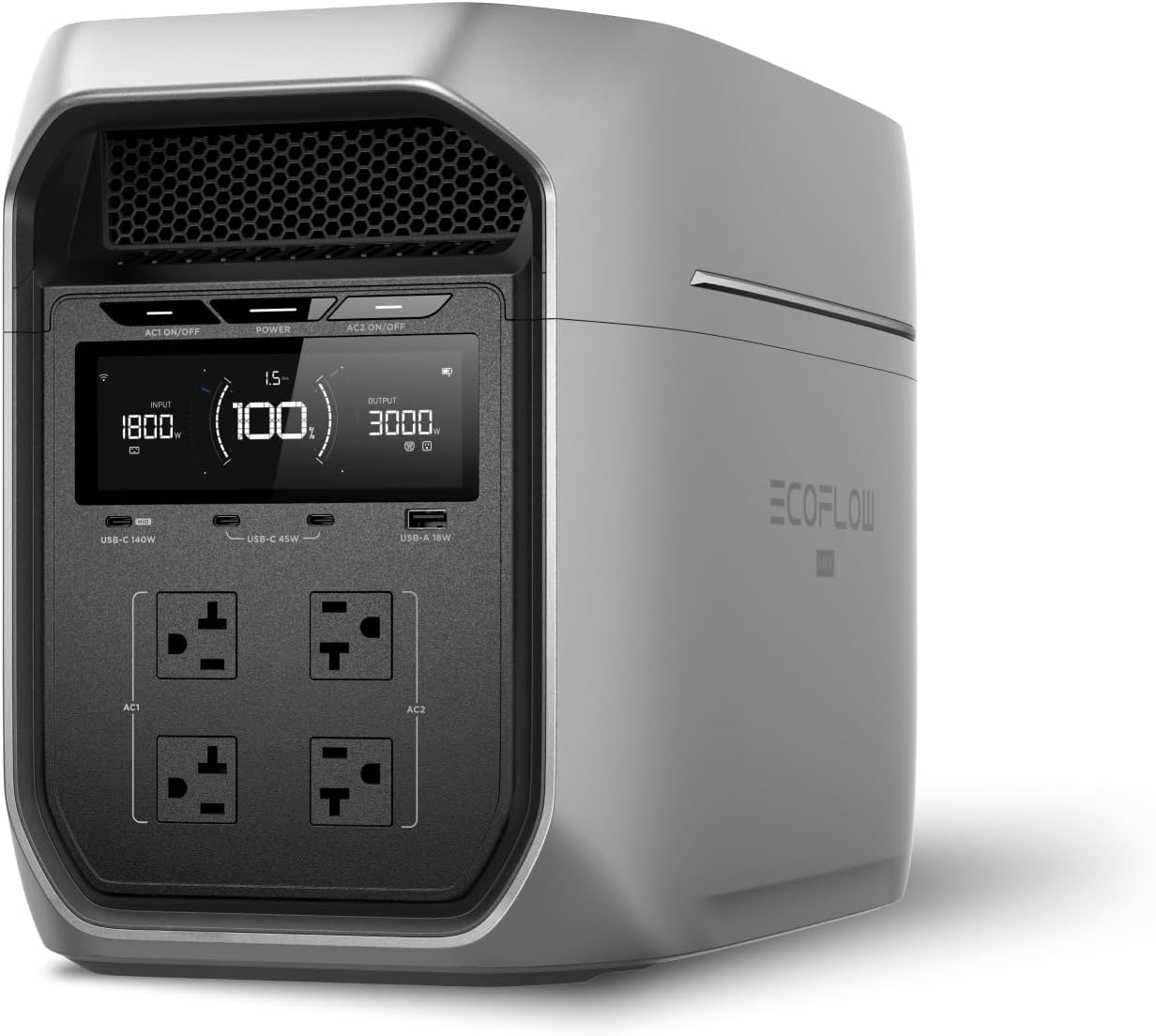
EcoFlow DELTA 3 Max Plus
- Advertised
- 2,048 Wh
- Usable, est. 85% inverter
- 1,741 Wh
- Continuous
- 3,000 W
- Surge
- 6,000 W
- Chemistry
- LiFePO4 (LFP)
- Rated cycles
- not stated
- Weight
- 48.7 lb
About 1,741 Wh usable behind a 3,000 W inverter with a stated 6,000 W surge, twice the margin rule, so the compressor is never the question. About six and a half hours at a 50% duty cycle, a full night on a mild one, and a 10 kWh expansion path for a heat wave. EcoFlow describes a ten-year lifespan without a cycle count, so that cell reads not stated.
Pros
- 6,000 W stated surge; 3,000 W continuous
- About 6.5 hours at 50% duty; expandable to 10 kWh
Cons
- Cycle count not stated; 48.7 lb
All-night pick
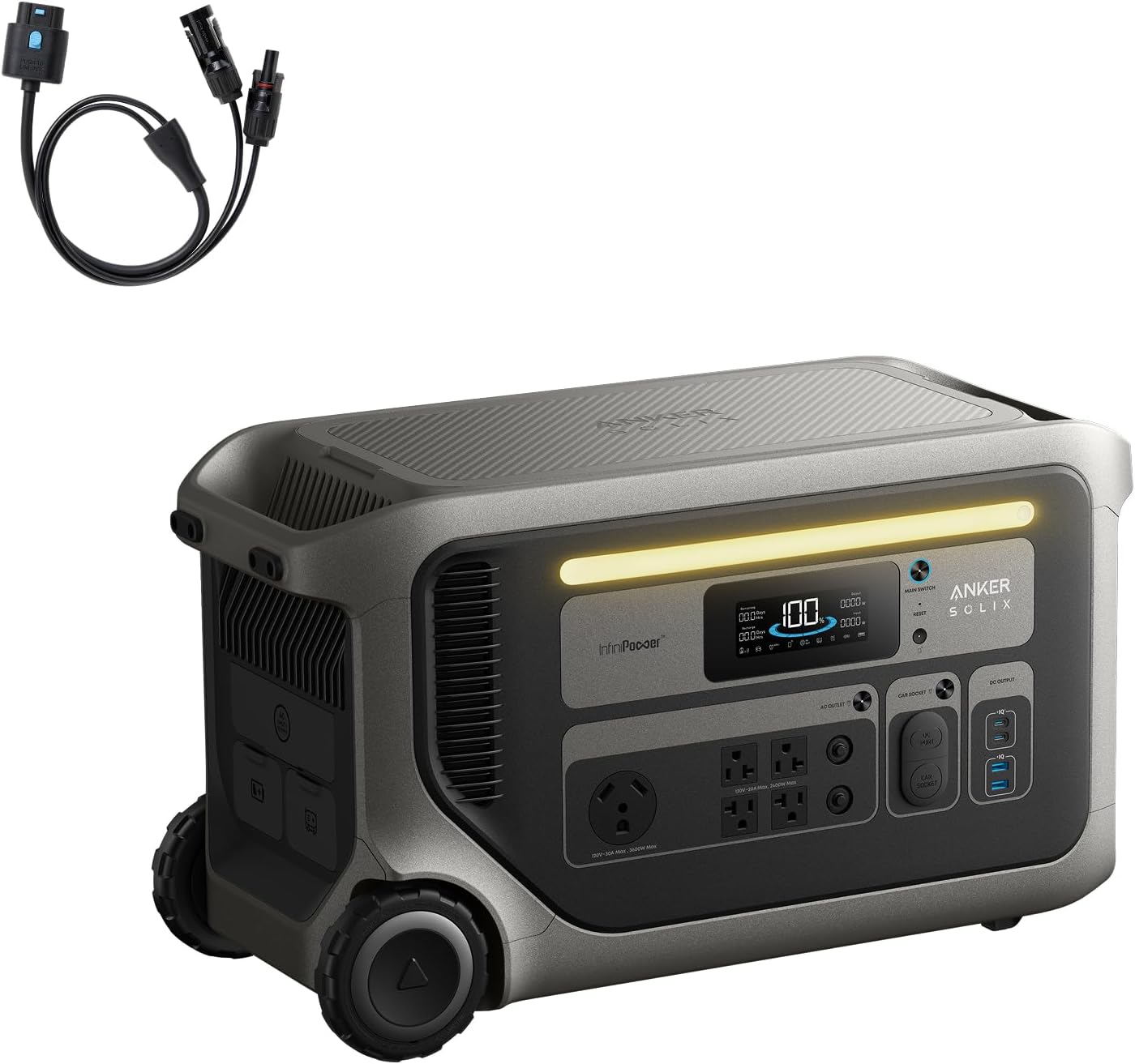
Anker SOLIX F3000
- Advertised
- 3,072 Wh
- Usable, est. 85% inverter
- 2,611 Wh
- Continuous
- 3,600 W
- Surge
- 7,200 W
- Chemistry
- LiFePO4 (LFP)
- Rated cycles
- not stated
- Weight
- 91.5 lb
About 2,611 Wh usable, roughly ten hours at 50% duty, with a stated 7,200 W surge and 2,400 W of solar input for the daytime refill that an AC needs more than any other load. Anker states 4,000 cycles without a capacity basis, so the card prints the count and the blurb the caveat. Ninety pounds on wheels: this is the unit for a bedroom, not a tent.
Pros
- About 10 hours at 50% duty; 7,200 W stated surge
- 2,400 W solar input for a daytime refill
Cons
- 91.5 lb; top of the band
- Cycle basis not stated
Best with UPS
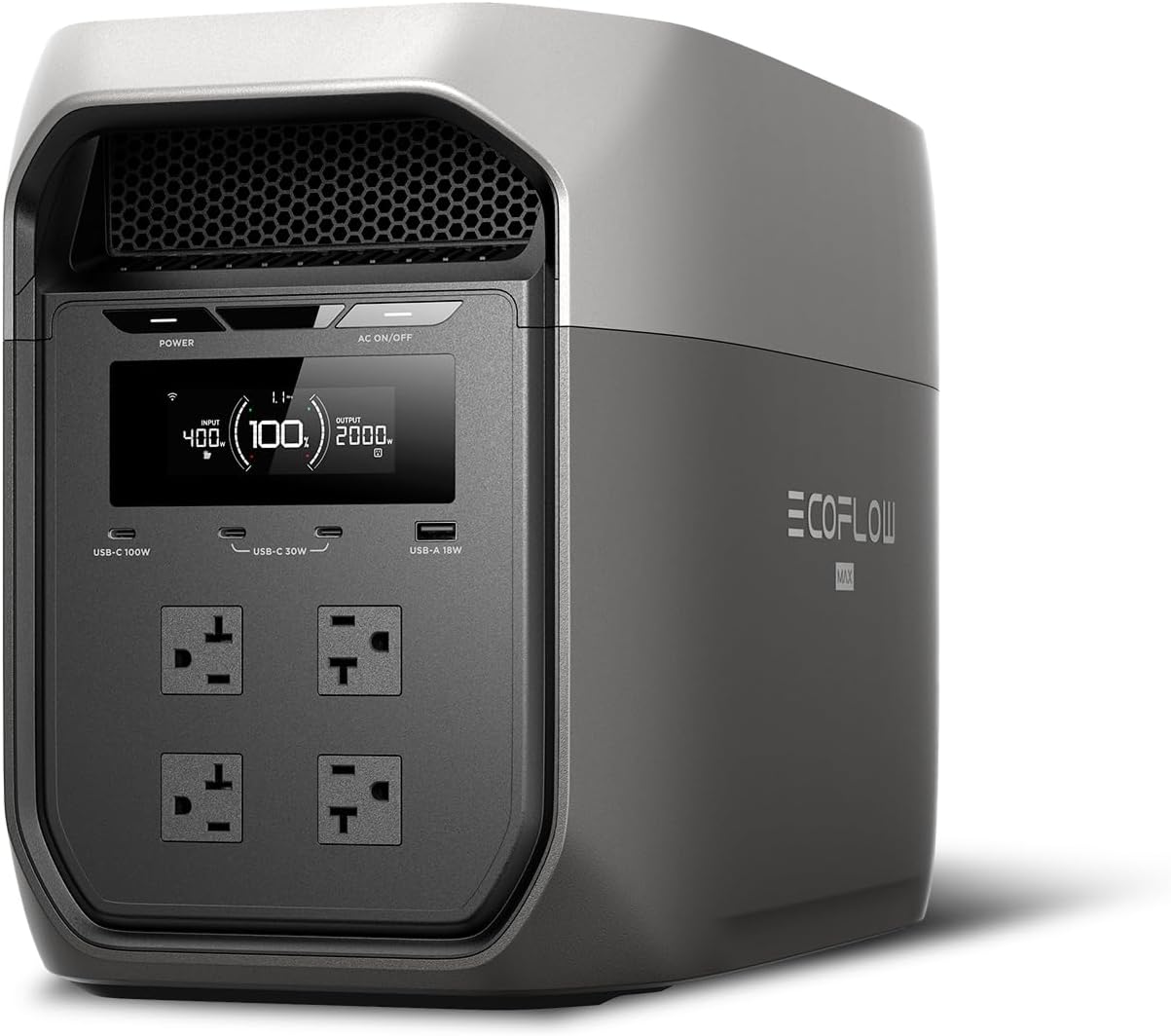
EcoFlow DELTA 3 Max
- Advertised
- 2,048 Wh
- Usable, est. 85% inverter
- 1,741 Wh
- Continuous
- 2,400 W
- Surge
- 4,800 W
- Chemistry
- LiFePO4 (LFP)
- Rated cycles
- not stated
- Weight
- 44.8 lb
The same 2,048 Wh and the same six and a half hours as the Plus, with 2,400 W continuous and a 4,800 W surge that still clears the rule with room, and a sub-10 ms UPS so the AC does not notice the grid drop. Four pounds lighter than the Plus and, at the check date, the same band. The choice between them is the extra 600 W of inverter for a second load.
Pros
- 4,800 W stated surge; sub-10 ms UPS
- Lightest 2 kWh unit here
Cons
- Cycle count not stated
A few hours, solar-ready
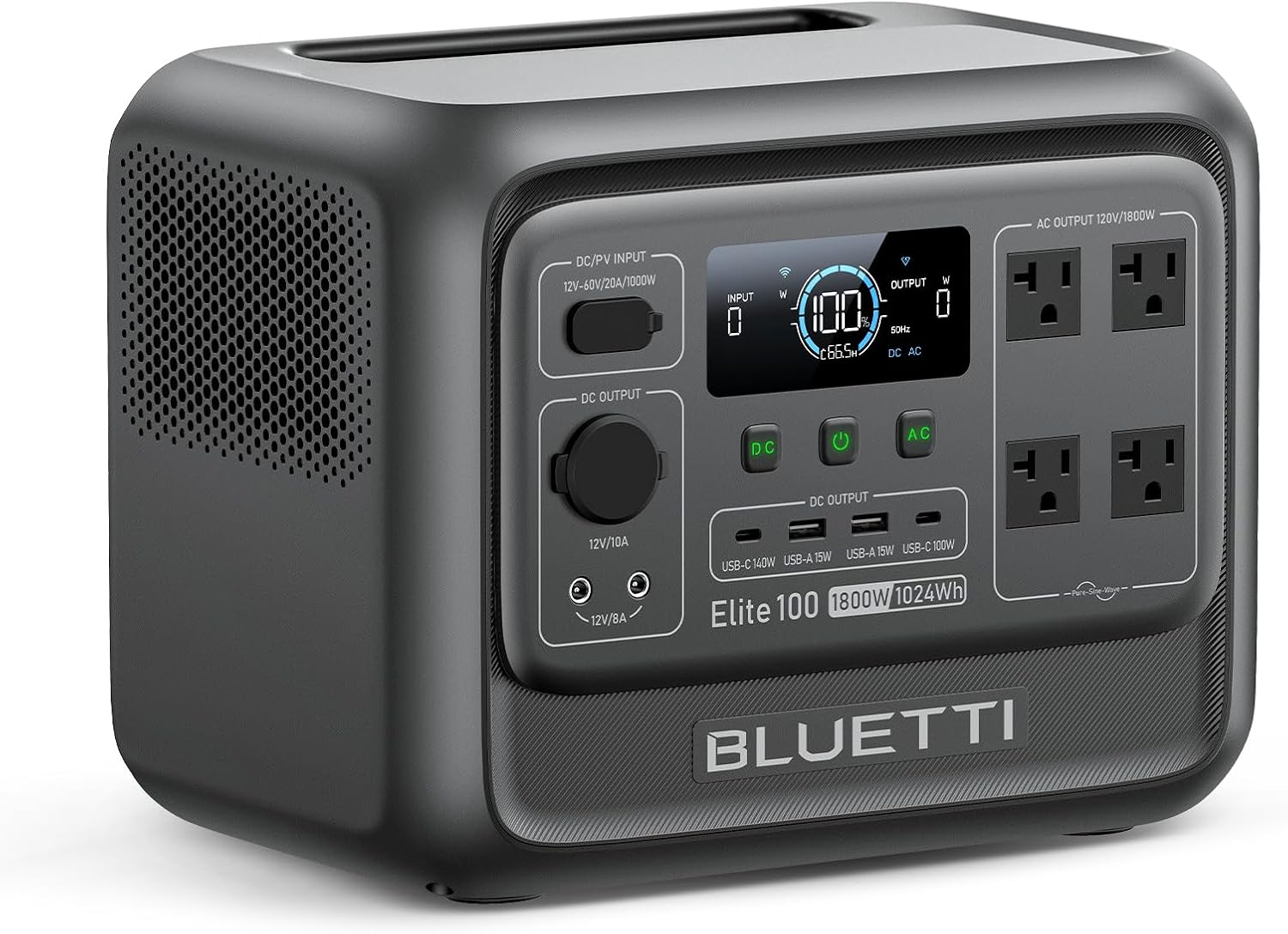
BLUETTI Elite 100 V2
- Advertised
- 1,024 Wh
- Usable, est. 85% inverter
- 870 Wh
- Continuous
- 1,800 W
- Surge
- not stated
- Chemistry
- LiFePO4
- Rated cycles
- 4,000 to 80%
- Weight
- 25 lb
About 870 Wh usable, about three hours at 50% duty, in a 25 lb unit with a 1,000 W solar ceiling that refills it in an afternoon on two panels. The 1,800 W inverter meets the continuous half of the rule; Bluetti states a 2,700 W Lifting figure for heating loads rather than a motor surge, so the surge half is not stated, and a compressor that trips it is the risk you take at this size.
Pros
- 4,000 cycles to 80%; 1,000 W solar input
- 25 lb; 10 ms UPS
Cons
- About three hours; motor surge not stated
Budget pick
Anker SOLIX C1000
- Advertised
- 1,056 Wh
- Usable, est. 85% inverter
- 898 Wh
- Continuous
- 1,800 W
- Surge
- not stated
- Chemistry
- LiFePO4
- Rated cycles
- 3,000 to 80%
- Weight
- 28.4 lb
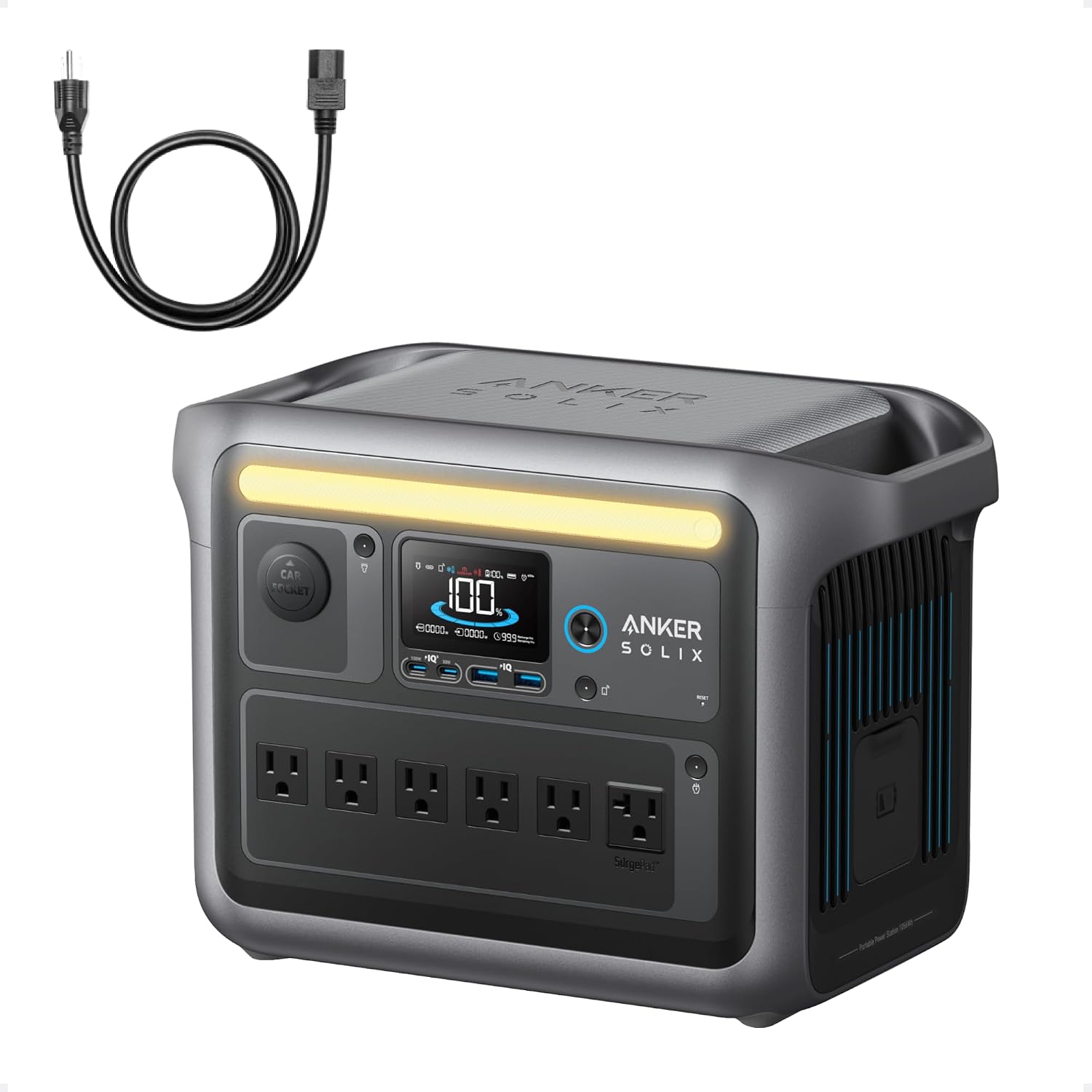
About 898 Wh usable and 1,800 W continuous at the bottom of the band, with four UL standards stated by number, which no other unit here does. Anker's 2,400 W SurgePad is a boost mode rather than a motor rating, so surge reads not stated; on a small AC that has started fine on an 1,800 W inverter it is the value buy, and about three and a half hours at 50% duty.
Pros
- Lowest band; four UL standards stated
- About 3.5 hours at 50% duty
Cons
- Motor surge not stated; 3,000 cycles
Also worth considering
Well-reviewed units that just missed the ranked list. Worth a look if the picks above are not quite right for you.
- EcoFlow DELTA Pro 3,600 Wh with a stated 7,200 W surge and 3,500 cycles to 80%, about eleven and a half hours at 50% duty. Still a clean spec sheet; it sits here rather than in the lineup because the F3000 does the same job for less on the check date.
- EcoFlow DELTA Pro 3 4,096 Wh, 4,000 W and 240 V output with a stated UL 9540 listing: the unit for a 12,000 BTU or a 230 V window unit, at a price that belongs on the whole-house page rather than this one.
Frequently asked questions
How many watts does a window air conditioner use?
Divide the BTU rating by the CEER on the yellow label. An 8,000 BTU unit at a CEER of 15 draws about 533 W while the compressor runs; a 12,000 BTU unit at the same efficiency draws about 800 W. The average over an hour is lower because the compressor cycles.
How long will a power station run a window AC?
At 533 W running and a 50% duty cycle, about 3 hours from a 1 kWh unit, 6 to 7 hours from a 2 kWh unit, and about 10 hours from a 3 kWh unit, at 85% inverter efficiency. Hours halve if the compressor never cycles off.
Can a small power station start a window AC?
Usually not. A compressor starts with a spike several times its running draw, and AC makers do not print the figure. This site's rule for an unpublished compressor is an inverter with at least 1,800 W continuous and 3,000 W surge, which rules out every 288 Wh unit and most 500 Wh ones.
Is a battery a sensible way to run air conditioning?
For one small room, for a night, yes. For a house, no: cooling is the largest load most homes have, and the whole-home page covers installed systems. A fan draws a tenth of an AC and is the better first spend on a battery.