Best solar generator: five station-and-panel kits ranked by what a day of sun puts back
Five power station and panel kits ranked on usable watt-hours, the panel's real output at the maker's own 75% figure, refill hours and the unit's solar ceiling.
“Solar generator” is the customer’s name for a power station sold with a folding panel, and the panel is the half the box oversells. A 200 W panel is a 150 W panel in real use, by the maker’s own planning figure, and a day of sun through it puts back about 600 Wh. So the kits below are ranked the way a kit should be judged: usable watt-hours in the battery, what the panel really delivers, how many sun-hours a refill takes, and how much more panel the station can accept. Every figure is from the maker’s page and dated on the card.
The arithmetic every kit is judged on
Three numbers, all on the solar guide. Rated watts are measured under laboratory conditions; EcoFlow’s own guidance is to expect about 75% in real use, and this site uses that figure for every maker. Usable watt-hours are the sticker at 85% inverter efficiency, per the usable capacity guide. And the station’s solar input ceiling caps how fast any number of panels can refill it.
| Kit | Usable Wh | Panel, rated and real | Sun-hours to refill | Wh back at 4 sun-hours | Solar ceiling |
|---|---|---|---|---|---|
| DELTA 2 Max, 2 x 220 W | about 1,741 | 440 W, about 330 W | about 5.3 | about 1,320 | 1,000 W |
| Jackery 1000 v2, 200 W | about 910 | 200 W, about 150 W | about 6.1 | about 600 | not stated |
| DELTA 2, 220 W | about 870 | 220 W, about 165 W | about 5.3 | about 660 | 500 W |
| AC180, 200 W | about 979 | 200 W, about 150 W | about 6.5 | about 600 | 500 W |
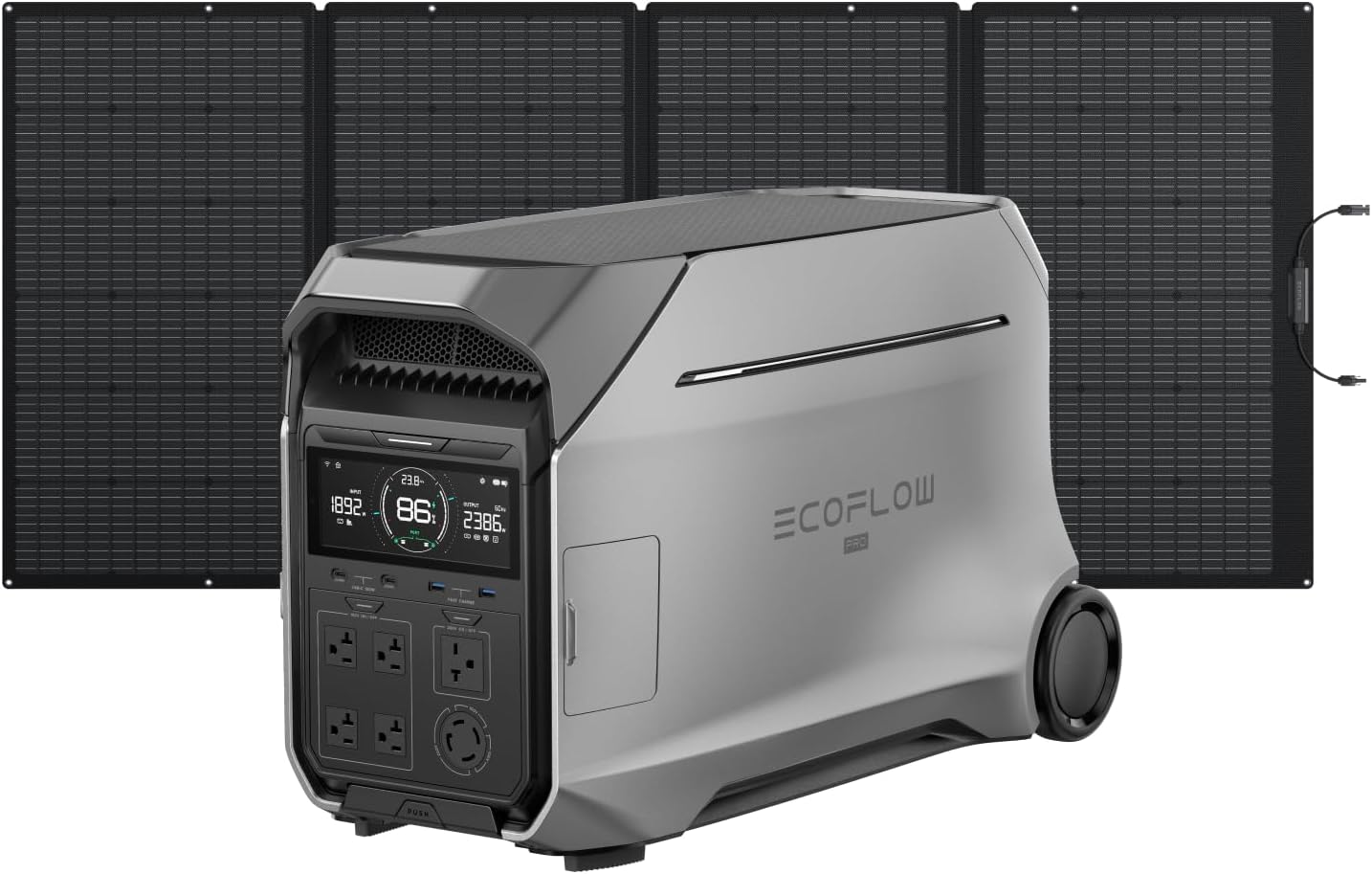
| DELTA Pro 3, 400 W | about 3,482 | 400 W, about 300 W | about 11.6 | about 1,200 | 2,600 W |
Sun-hours are peak sun hours, the number of hours of full-strength sun a location averages: four to six in a U.S. summer, two to four in winter, before weather. A refill figure above six means the kit as sold does not refill in a day.
Match the kit to the job
Essentials through a multi-day outage. A refrigerator, phones, router and a CPAP come to about 2.5 kWh a day on the 3-day plan. The DELTA 2 Max kit’s two panels put back about half of that on a clear day, which turns its 1.7 kWh into a battery that lasts as long as the sun keeps coming; every single-panel kit puts back a quarter. Tick your list in the sizing calculator with the solar option on and it prints the gap.
One appliance, one week of camping or a garage. Any 1 kWh kit. The Jackery has the most reviews and the lightest station; the DELTA 2 is the one to pick if an extra battery is in the plan; the AC180 has the most watt-hours for the least money and a 500 W ceiling for a second panel.
A well pump, a 240 V circuit, an inspector. Only the DELTA Pro 3 kit, and read its row honestly: one 400 W panel is a token against 3.5 kWh. Budget for three more panels or a generator input, and for the transfer switch a licensed electrician installs; the expandable roundup covers the station itself.
What the kit adds, and what it does not
A kit saves buying the panel and the cable separately and usually prices the panel below its standalone listing. It does not change the station’s ceiling, its surge rating, or its cycle life, which is why the spec strip on each card is the station’s and the panel’s figures are in the blurb. Two things a kit never includes: a way to keep the panel aimed at the sun for six hours, and any output at night. A unit that also charges from the wall or a vehicle, which all five do, is the one to own; solar is the top-up, not the plan. The 2 kWh stations that anchor the top kit are compared as stations, without panels, on the 2 kWh roundup.
What we left out
Anker’s C2000 Gen 2 and Bluetti’s Elite 200 V2 bundles are new listings under 50 reviews, so they sit as honorable mentions rather than ranked picks. EcoFlow’s DELTA 3 Plus kit with the 220 W panel had no buy box on the check date. Jackery’s 2000-class kits were unavailable at Amazon. No kit’s maker states a UL 2743 listing for the station; the DELTA Pro 3’s UL 9540 is the only listing printed here, and the certification guide explains what it covers.
How we measure
Every pick is scored on the same five criteria. Every capacity, output and certification figure is read from the manufacturer's current spec sheet at write time and dated on the card, and every runtime is computed from those figures with the arithmetic shown. When a maker does not publish a number, the card says "not stated". We never guess one.
-
Usable capacity
The advertised watt-hours against what reaches the outlet: inverter loss, the depth-of-discharge limit and idle self-consumption. We state usable capacity, not the sticker.
-
Output headroom
Continuous and surge watts against the appliances readers actually plug in. A pump that pulls 3 to 5 times its running watts at start trips an underspecced inverter; we check the surge number first.
-
Chemistry and certification
LiFePO4 versus NMC, the rated cycles to 80%, and whether the unit carries UL 2743, UL 9540 or UL 1973. We print the certification status plainly and never treat an uncertified import as equivalent.
-
Recharge and expansion
Wall recharge time, the solar input ceiling and what it means for real charge time, pass-through or UPS switchover, and whether there is an expansion-battery path.
-
Value and warranty
Price per usable kilowatt-hour, weighted by warranty years. A maker that guarantees its cycle rating in writing is telling you something the spec sheet cannot.
Price bands, relative to the picks on this page: $ budget · $$ mid-range · $$$ premium · $$$$ top shelf. Retailer prices move constantly, so we show bands rather than dollar amounts; each button shows the live price.
Best overall
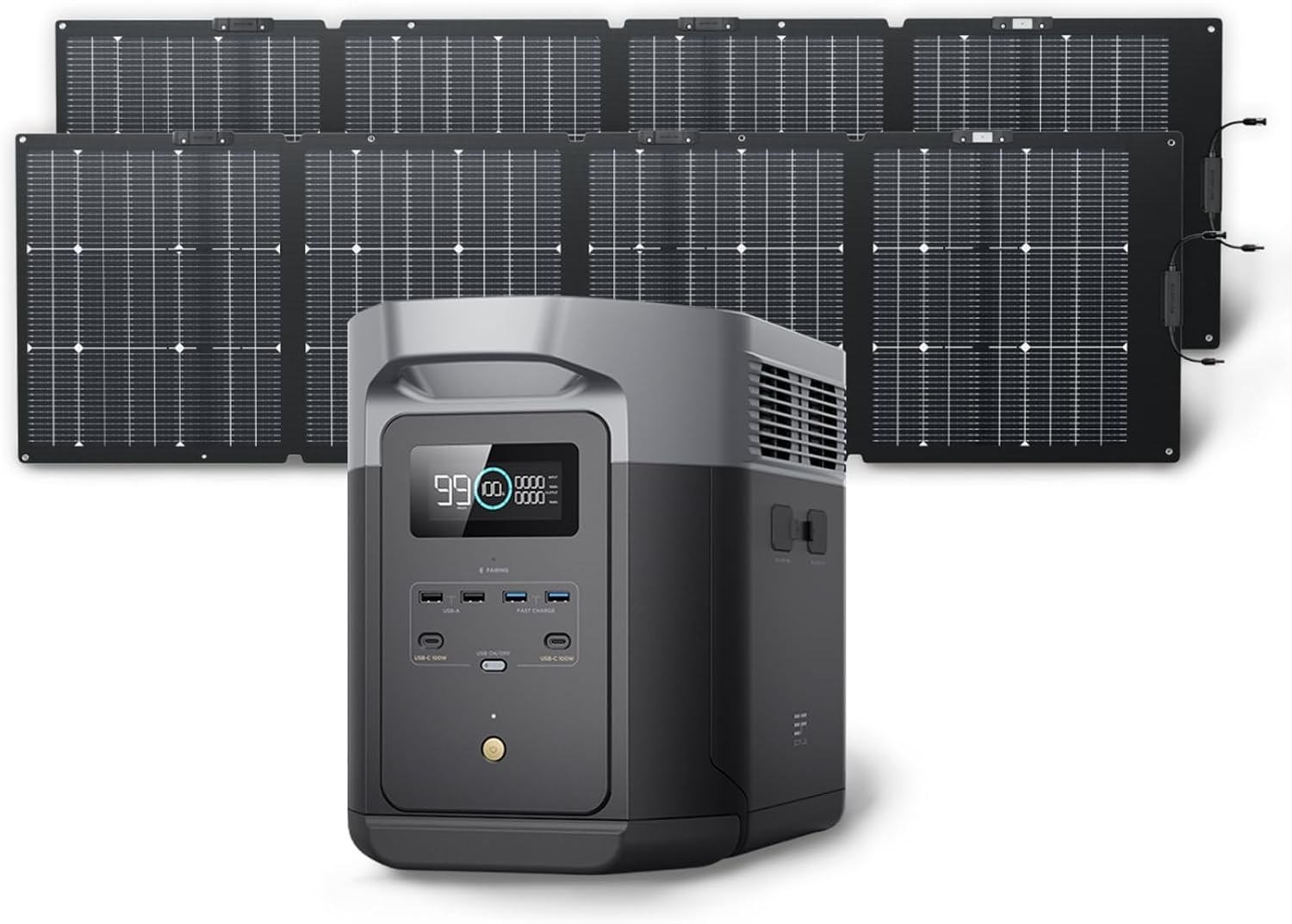
EcoFlow DELTA 2 Max solar generator, 2 x 220 W
- Advertised
- 2,048 Wh
- Usable, est. 85% inverter
- 1,741 Wh
- Continuous
- 2,400 W
- Surge
- 4,800 W
- Chemistry
- LiFePO4 (LFP)
- Rated cycles
- 3,000 to 80%
- Weight
- 50 lb
The only kit here whose panels refill the battery in a working day: two 220 W bifacial panels, about 330 W together at the 75% figure, against 1,741 Wh usable is a little over five hours of strong sun, and the station's 1,000 W solar ceiling leaves room to add more. EcoFlow rates each panel 220 W front and 175 W rear at 25% cell efficiency, 15.4 lb, IP68. The 4,800 W surge starts any pump on this site.
Pros
- Two panels, 1,000 W solar ceiling, about five sun-hours to refill
- 4,800 W surge and expansion to 6,144 Wh
Cons
- Heaviest station of the five at 50 lb, plus 31 lb of panel
- 3,000 cycles to 80%, the lowest rating here
Best 1 kWh kit
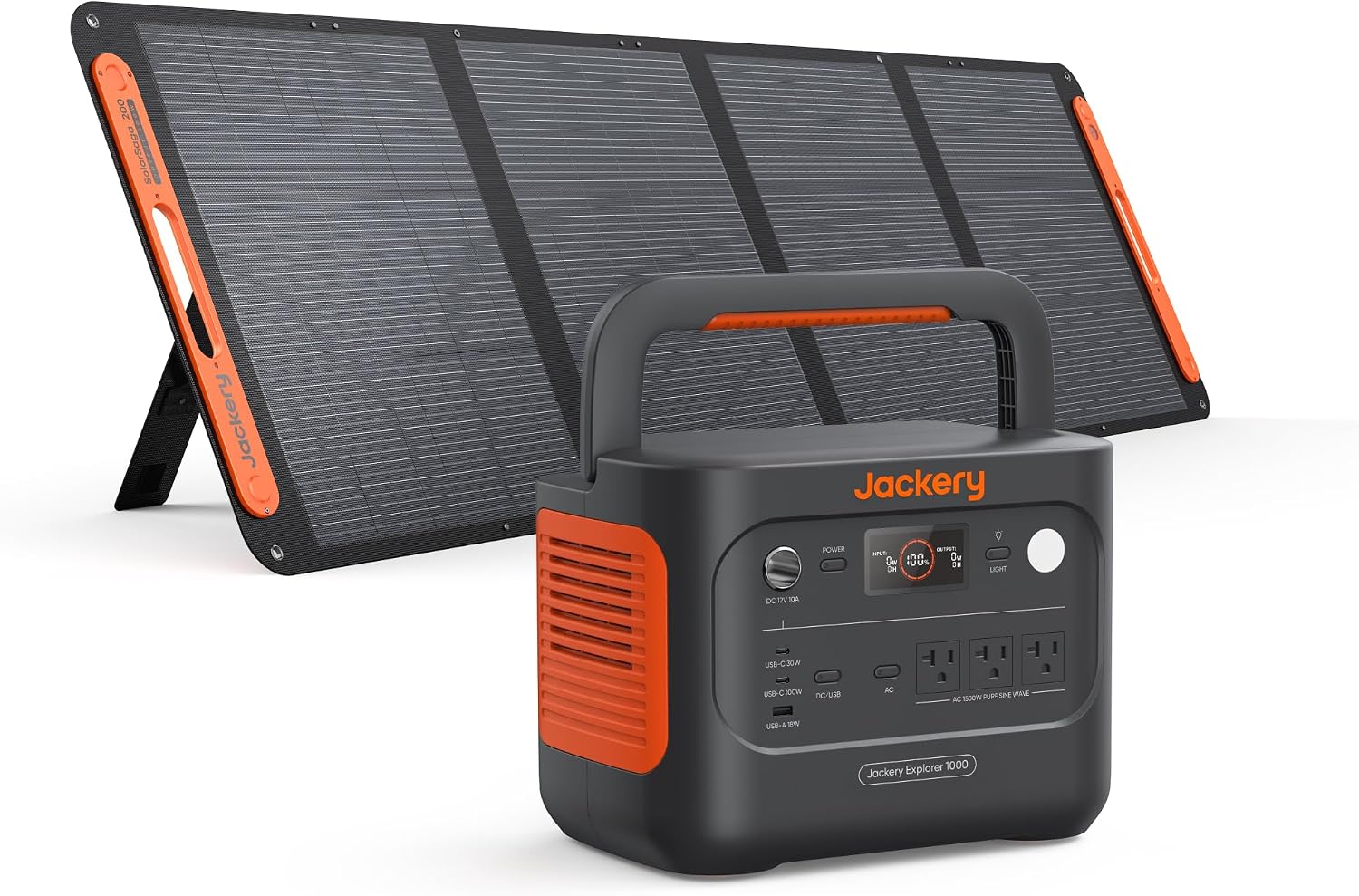
Jackery Solar Generator 1000 v2, 200 W
- Advertised
- 1,070 Wh
- Usable, est. 85% inverter
- 910 Wh
- Continuous
- 1,500 W
- Surge
- 3,000 W
- Chemistry
- LiFePO4
- Rated cycles
- 4,000 to 70%
- Weight
- 23.8 lb
About 910 Wh usable in a 23.8 lb station with a 200 W bifacial panel Jackery rates at 24.3% conversion and IP68; at 150 W real that is about six sun-hours to refill, and roughly 600 Wh a day at four. The most-reviewed kit in this class by a wide margin. Jackery rates cycles to 70% rather than 80%, states no safety listing, and prints no solar ceiling on the page we read, so the card says so.
Pros
- Lightest station here; 200 W panel in the kit
- Budget band for a 1 kWh kit
Cons
- Cycle rating is to 70%, not 80%
- Solar input ceiling not stated on the product page
Best expandable 1 kWh kit
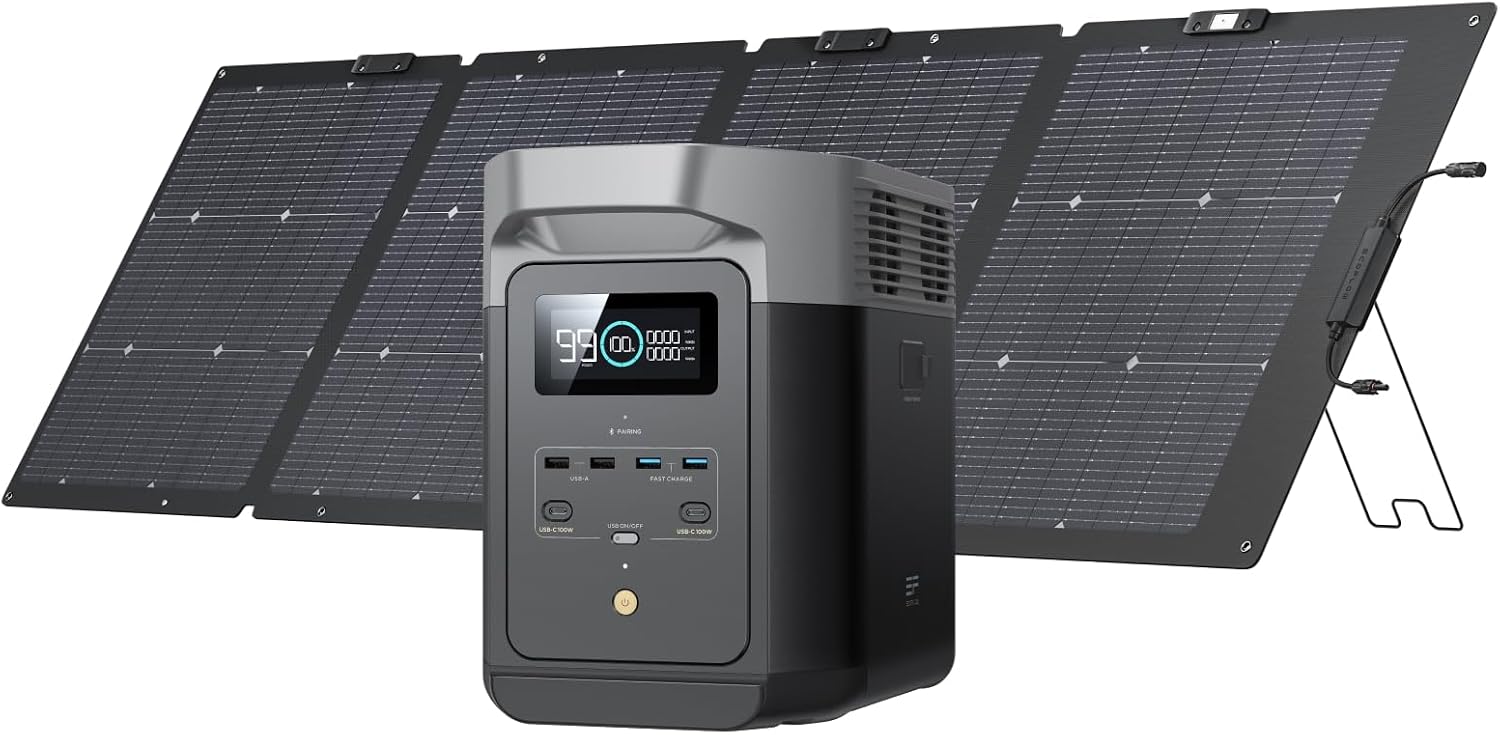
EcoFlow DELTA 2 solar generator, 220 W
- Advertised
- 1,024 Wh
- Usable, est. 85% inverter
- 870 Wh
- Continuous
- 1,800 W
- Surge
- not stated
- Chemistry
- LiFePO4
- Rated cycles
- 3,000 to 80%
- Weight
- not stated
About 870 Wh usable behind an 1,800 W inverter, with the same 220 W bifacial panel as the DELTA 2 Max kit: about 165 W real, five and a bit sun-hours to refill, and a 500 W ceiling that accepts a second panel. EcoFlow states 3,000-plus cycles to 80% and an X-Boost figure of 2,200 W, which is a resistive-load mode rather than a motor surge rating, so surge reads not stated. The page gives no weight figure.
Pros
- Expandable to 3 kWh with the extra battery
- Same 220 W bifacial panel as the flagship kit
Cons
- Motor surge rating and weight not stated on the maker's page
Best budget kit
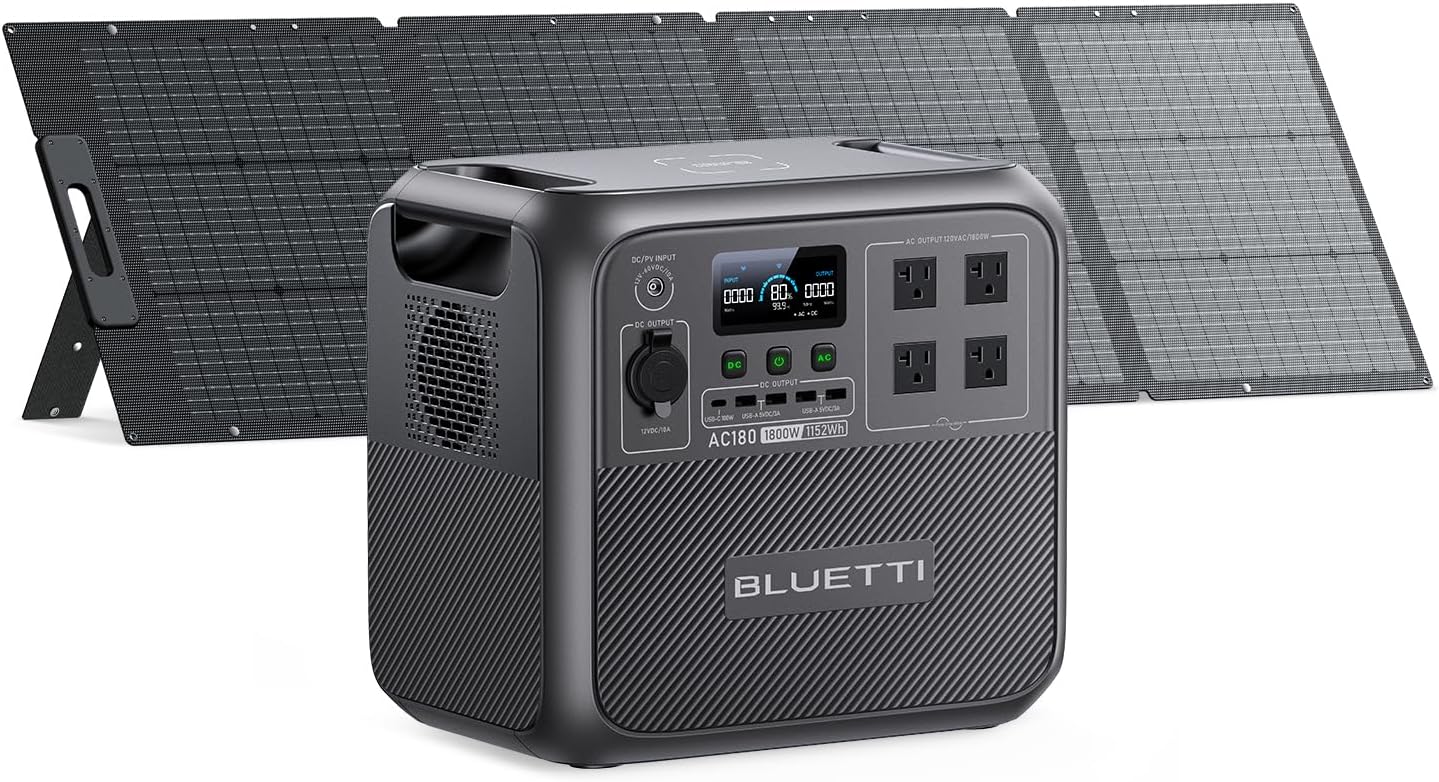
BLUETTI AC180 solar generator, 200 W
- Advertised
- 1,152 Wh
- Usable, est. 85% inverter
- 979 Wh
- Continuous
- 1,800 W
- Surge
- not stated
- Chemistry
- LiFePO4
- Rated cycles
- not stated
- Weight
- 35.3 lb
The most usable watt-hours in the budget band, about 979 Wh, with a 500 W solar ceiling and Bluetti's PV200 panel: 200 W, 23.4% cells, 16.1 lb, IP65, so about 150 W real and six and a half sun-hours to refill. Bluetti states 3,500-plus cycles without a capacity basis and a 2,700 W Power Lifting figure for heating loads rather than a motor surge, so both cells read not stated.
Pros
- Largest capacity in the band; 500 W solar ceiling
- Most reviews of any kit here after the Jackery
Cons
- Surge rating and cycle basis not stated by the maker
- Heaviest 1 kWh station here at 35 lb
Whole-home class
EcoFlow DELTA Pro 3 solar generator, 400 W
- Advertised
- 4,096 Wh
- Usable, est. 85% inverter
- 3,482 Wh
- Continuous
- 4,000 W
- Surge
- not stated
- Chemistry
- LiFePO4 (LFP)
- Rated cycles
- 4,000 to 80%
- Weight
- 113.5 lb
The one kit with 240 V output and a stated UL 9540 listing, about 3,482 Wh usable, and a 2,600 W solar ceiling across two ports. The single 400 W panel in the kit, about 300 W real at up to 23% conversion and IP68, needs close to twelve sun-hours to refill it; this is a station built for four panels sold with one. EcoFlow states no motor surge figure for it, so the card says not stated.
Pros
- 240 V output, UL 9540 stated, 2,600 W solar ceiling
- About 3.5 kWh usable, expandable
Cons
- One 400 W panel refills it in two clear days, not one
- 113.5 lb station; the kit ships in two boxes
Also worth considering
Well-reviewed units that just missed the ranked list. Worth a look if the picks above are not quite right for you.
- EcoFlow DELTA Pro solar generator, 400 W The previous flagship, 3,600 Wh with a stated 7,200 W surge, still buyable as a kit with the same 400 W panel and a 1,600 W solar ceiling. The DELTA Pro 3 replaces it on 240 V and certification; on surge it is still the stronger number.
- Anker SOLIX C2000 Gen 2 with PS200 bifacial The best-value 2 kWh station on this site, 4,000 cycles and 41.7 lb, with Anker's 200 W bifacial panel at 10.6 lb and IP68. The bundle listing had six reviews on the check date, below the ranking floor; it moves up when the listing matures.
- BLUETTI Elite 200 V2 with 200 W panel 2,073.6 Wh and 2,600 W in the kit form of the 2 kWh roundup's third pick. Buyable, 4.7 stars, 37 reviews on the check date, so an honorable mention until it clears 50.
Frequently asked questions
What is a solar generator?
A portable power station sold with one or more folding solar panels. There is no engine and nothing is generated on the spot: the battery stores energy, the panel refills it in daylight, and the inverter turns it into outlet power. The kit is the product, which is why this page ranks kits rather than stations.
How long does a solar generator take to recharge?
Usable watt-hours divided by the panel's real output, then by the hours of strong sun. At EcoFlow's own planning figure of about 75% of the label, a 2,048 Wh unit on two 220 W panels needs about five hours of strong sun; a 1 kWh unit on one 200 W panel needs about six. Most of the country sees four to six such hours in summer and two to four in winter.
Can a solar generator run a house?
A kit can carry the essentials, about 2.5 kWh a day for a refrigerator, phones, router and a CPAP, and the largest kit here can start a well pump. No single folding panel refills that much in a day, so the honest plan is a battery sized for a day and a panel that puts back a meaningful share of it. The 3-day plan and the calculator do that arithmetic.
Why are the Anker and Bluetti kits not ranked?
The Anker SOLIX C2000 Gen 2 and Bluetti Elite 200 V2 kits are strong stations with new bundle listings that had fewer than 50 reviews on the check date, below this site's floor for a ranked pick. They are listed as honorable mentions and will be ranked when their listings mature. The EcoFlow DELTA 3 Plus kit had no buy box on the check date.